Hats off: A brief return to Anglican Christianity
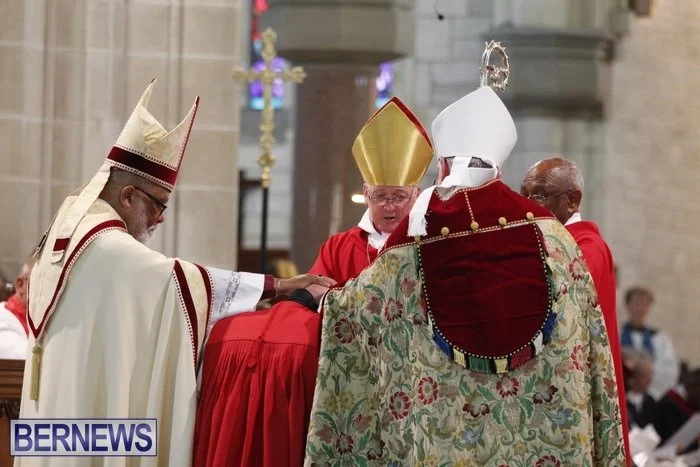
A cousin from overseas is visiting. He is a member of the United Church of Canada, and intends to study towards ordination in the coming years. So he was interested in attending some local services while here, including a service at our local Anglican cathedral. I offered to come along.
Having left ‘traditional’ (modern) church many months ago, after 47 years of regular attendance and participation, I was intrigued as to how I would find it.
Hats not allowed
My first experience wasn’t great. As we went to sit down in some seats towards the back, a local cathedral volunteer came over and quietly asked another visitor, a young Filipino man with his family, to take off his hat. Really? The clergy are allowed to wear all sorts of costume, the bishop his mitre (though the current bishop - not in attendance for this service - doesn’t follow this custom)! I couldn’t see any NO HATS PERMITTED signs. I felt angry and embarrassed on the young man’s behalf.
The service was an evensong. Ah, the height of Anglicanism I said to my cousin before we arrived. I was looking forward to the song bit. I am still surprised by how much I feel satisfied with (Quaker) “Meeting for Worship”, and that I don’t really miss the traditional, liturgical elements that I grew up with. Tonight might test that afresh.
But music, song. Yes, that melts my heart and attracts my soul. Technically, there is nothing against Quakers singing or playing music. There is usually a piano in every Meeting House just in case the Spirit moves someone spontaneously in that direction. In practice, liberal Quakers rarely sing. They stand up and speak, or just keep silent.
Addendum: Why Quakers don't do physical sacraments
On the way over, my cousin and I discussed whether we’d go up for communion or not (I discovered communion isn’t offered at evensong - not, at least, the evensong we attended). It's a drag to put it all here, so see the addendum at the end of this post if you're interested in why Quakers don't do physical sacraments.
God is Up There
My next strong impression was how the interior space was arranged in terms of seating etc. All these chairs lined up in square rows, just like school assembly or a musical or theatre performance, focusing our attention on the ‘stage’ in front of us, and certainly not on each other or within. Yuck. I have such a strong, long-standing sensory objection to this way of arranging worship. It all came flooding back. Don’t focus on the presence within. Or the Presence in the Midst. Don’t feel into the presence in the space between all these beautiful, wounded, people. Everyone face the front. Sit up straight. Take your hats off! God is Up There and Out There.
Am I being too harsh?
And then they started singing. A musical group (“Conspiro”) started singing behind us. A Psalm perhaps, or an ancient hymn. It doesn’t matter. Beautiful sounds and heart-shapes, warming our backs. Old words, hard to make out sometimes, rather opaque in terms of their meaning. But who cares. My soul began to relax and melt.
The music fed me through the service, which in itself continued to feel stiff, awkward, and rather bizarre. Anglican services are notable for their little book of words, the service sheet. The service sheet we were given was full of words and, of course, instructions for what to do- stand up at this point in the sung Psalm, sit down at this point in the Psalm. As my cousin later said, standing up to sing makes physical sense: it frees the diaphragm for breathing and the voice for sounding. But this - stand up, sit down, stand up - just felt ridiculous. And a great interruption to simply listening to and taking in the beautiful music.
I discarded my service sheet and stayed sitting for most of the service.
Psycho-theological games
Early on in the service, we came to the Confession of Sins and Absolution. This was something I've often felt ambivalent about, but I was surprised at how bizarre it all felt and sounded. It struck me we were being invited to play a little word game. A psychological-theological word game with, supposedly, great implications for our souls.
Whether we felt it or not in the moment, we were invited to pretend we felt very guilty and bad, and needed to confess this and somehow wipe it out before the rest of the service could proceed. Only we flew through the words so quickly: I confess to Almighty God, and to you my brothers and sisters, that I have sinned….in thought and in deed… (oh, maybe I’m remembering the Roman Catholic Version)….
I am not trying to deny that at times in our lives, in my life, I have felt very guilty and bad and in urgent need of healing and forgiveness. But to contrive this at the start of every service?
Then the priest stood up and forgave us all, and we completed the language game of Confession and Absolution and got on with the rest of the service.
I am not against the need for an “entrance”, for a symbolic and spiritual “gate” or process that takes us into a deeper sense of sacred space. It’s just this whole Confession and Absolution felt so forced and inauthentic. Something we had to adopt and play along with, regardless of how we truly feel in that moment. And I realized that a whole lot of my participation in traditional Christianity has been a trying hard (at times, not all the time) to fit myself into contrived emotional states, theological frames, and language games that don’t particularly fit how and who I truly am. God, it’s so good to let this all go! Is this how the first Protestants, the first Christians, felt, too?
The helpful phrase “language game” came back to me when I listened to the sermon. Thankfully, the preacher was of such an important standing that he didn’t apparently need the rather officious-looking verger, with the heavy metal sceptre in her hand, to accompany him to the lectern and back (as she had with those that read ‘the lessons’). I was glad that my cousin was hearing this man preach as he is one of the most intelligent and progressive voices in the diocese. But as polished and interesting as his sermon was, I was struck by how bizarre I now found the way he talked about ‘God’.
The preacher referred to the Jesuit practice of examining the events of the day (‘the Ignatian examen’), or even the events of past years, and discerning where ‘God’ had been most present, where ‘God’ had been sort of participating with us in such and such a moment. For many years, I wouldn’t have had much of a problem with this language. But now it struck me as bizarre. ‘God’ as this bubble of super-personality and goodness that pops out of the stream of our life in this or that a moment. An interventionist ‘God’ who pops out and intervenes at certain times (mostly good), but is appallingly silent and seemingly absent at other moments.
Our language is a rich form of consciousness; at the same time, it falls short of the mystery of actual life:
But my spirit hasteneth from words…(that it) may sink…into the feeling of the life itself, and may learn what it is to enjoy it there and to be comprehended of it, and cease striving to know or comprehend concerning it. (1)
Stay with the experience of the life [within you], and this will free you from a dependence on words. (2)
Perhaps some language games are better than others. Maybe ‘God’ is ok as a pragmatic place-holder for the great mystery of our lives, the world, and beyond. Or maybe ‘God’ inevitably involves us in language games of a Supernatural Being, one separate from ourselves and reality, doing essential violence to all elements in the process.
In contrast to this ‘God’, and in response to the human need to know a name, Exodus simply gives us I am who I am.
Tonight’s performance is…
Ritual is an essential part of culture, religious experience, and the creation and transformation of consciousness. The modernist experiment that we can live without such embarrassing and awkward cultural elements has produced a thin, arid culture and spirituality, many would claim. At its best, ritual takes us out of our safe, fortified minds and introduces us to the risk and joy of collective, symbolic practice.
And yet, we are entitled to ask: what is the point of this or that ritual? What is its intention for me? What, through my attendance and participation, however minimal, am I tacitly consenting to and reinforcing?
I look at the Dean of the Cathedral. He is wearing a billowing, white gown and floral cape. I look at the priest who is ‘presiding’ today. She is wearing a massive, white tent, tied off with a tight piece of plastic around her neck. I think of the man who wore his cap in here, a visitor from the Philippines, attending this very English cultural-historical re-enactment for the very first time. I think, angrily, of the officious cathedral volunteer who pounced on him and asked him to remove his cap. I think how embarrassed he looked, how told off. How compliant and passive he was in response. What is being enacted?
Because it’s really not something to do with Jesus or the Spirit, is it? It’s something very odd and English, maybe of the fourteenth or sixteenth or eighteenth century. Something about order and goodness and hierarchy and power. Something about culture and belonging and beauty, too. It’s a sort of modern pastiche of elements from medieval, early modern, and modern English culture and Christian religion, with liberal borrowings from other times and places, no doubt. And maybe that’s all ok. We are English, aren’t we? But this?
The plaintive organ. The fussy service sheets. The gowned clergy. The ungowned, dutiful laity, all playing various language games with their emotions and beliefs. With some success. With limited success. The woman holding her heavy iron sceptre - the verger - accompanying the readers to the podium and back. Just in case, what? They do a runner at the last moment? They’re attacked by a member of the congregation, the audience - an irritable, recalcitrant Quaker? The physical arrangement of ‘God’ as Up There and Out There. The church members or attenders as audience. The Vicar as Christ. The main show. What’s going on?
The words “historical re-enactment” come to mind. In the sense of a small town re-enacting a famous, founding incident: when the first ships sailed in, when the first train came chugging through, when the town finally defeated this or that threatening neighbour or snake. When their sons returned from the war. When the whole town put on a large, turkey meal.
I know: it makes all the difference to be inside, to believe in this. You then feel connected. You belong. You forgive all the awkward parts, the falling short. God knows we all need an eternal family.
The British liberal Anglican, Theo Hobson, comes to a very different conclusion than I have arrived at, though feeling similar things at times. Of his decision to commit to ordination, he writes:
For years I felt: I half-like church, or feel the need for it, but I can’t really be myself there, because there’s a slightly fake pious atmosphere. But it gradually grew on me: secular social life is also a bit fake, everyone’s showing how laid-back and edgy and unjudgy there are, treating everything as material for witty repartee, and keeping their sincerity half-hidden. I’m someone who wants a bit more earnest shared culture as a ground for ‘being myself’. Social life has never felt quite enough – much as I like some of my friends. So, church has grown on me.
Hobson’s post, “Me, a priest?”, is worth reading further, and can be found here.
Hobson believes in joy:
You might feel that joy is to be found in extreme sports, or pop concerts, or snorting coke from the midriffs of hookers. But I think you mean pleasure. One gets pleasure from those things, not joy. Joy is deeper pleasure, linked to a sense of the goodness of existence.
It seems to me that joy is to be found in doing cultural things. I don’t mean going to plays or art galleries, I mean cultural things that are very participatory and democratic.
Anglican liturgy, participatory and democratic? Maybe. In some churches. In some smaller churches with more democratic values and leaders, perhaps. But on the whole: hardly. At the cathedral last night, at evensong: not at all. You just stay in your seat, stand up sit down, speak when you're told to, and don't wear a hat.
“Joy is to be found in doing cultural things”. This might be the best defence for an Anglican evensong, where the music indeed is beautiful. If you can submit to its rules and games.
The dream
I had a dream last night. I think it led to me writing this post, perhaps one of the last posts in this blog series.
In the dream I am being served a meal at a restaurant. A man ladles out some soup into my bowl - some pasta, a piece of potato, a small piece of some unrecognizable meat, and the grey, slimy liquid of the soup. This isn’t what I ordered! This isn’t what was promised on the tin! I take a photo of the meagre serving and complain. I complain, assertively, to the waiter and the chef. Other people around me, seated and eating their meals, think I am very rude for complaining. How rude! The waiter comes over and dishes out more of the same.
I think I’ll just pay my bill and leave now.
═══✿═══
Addendum: Why Quakers don't do physical sacraments
Briefly, to my mind, it centres around:
1. The idea that Jesus wasn’t primarily interested in creating new rituals and rites - creating a new religious system - but was more concerned to move Jewish practice further in the direction of the Spirit, of an authentic, inward relationship with God:
Our ancestors worshipped on this mountain, but you say that the place where people must worship is in Jerusalem.’ Jesus said to her, ‘Woman, believe me, the hour is coming when you will worship the Father neither on this mountain nor in Jerusalem….the hour is coming, and is now here, when the true worshippers will worship the Father in spirit and truth, for the Father seeks such as these to worship him. God is spirit, and those who worship him must worship in spirit and truth.’ (John 4: 20-24).
2. There is very little in the Gospels to justify physical communion as an ongoing, essential practice for Christians. Three Gospels record Jesus’s final meal with his disciples. Only one Gospel (Luke) records Jesus saying: ‘do this to remember me’. Likewise, there is very little in the Gospels to justify water baptism. To the best of my knowledge, there is no clear mention of Jesus baptising anyone - by water! He permits and perhaps instructs his followers to do so (see point three below). But, as John the Baptist himself says, Jesus’s mission is to baptize with the Spirit (and fire) - to announce and inaugurate a baptism or initiation into God or the kingdom of heaven that is intensely and singularly ‘of the Spirit’:
Jesus answered him, ‘Very truly, I tell you, no one can see the kingdom of God without being born from above.’ Nicodemus said to him, ‘How can anyone be born after having grown old? Can one enter a second time into the mother’s womb and be born?’ Jesus answered, ‘Very truly, I tell you, no one can enter the kingdom of God without being born of water and Spirit. What is born of the flesh is flesh, and what is born of the Spirit is spirit. Do not be astonished that I said to you, “You must be born from above.” The wind blows where it chooses, and you hear the sound of it, but you do not know where it comes from or where it goes. So it is with everyone who is born of the Spirit.’ Nicodemus said to him, ‘How can these things be?’ Jesus answered him, ‘Are you a teacher of Israel, and yet you do not understand these things? (John 3: 3-10).
3. Many Quakers have taken a more tolerant, pragmatic approach to physical sacraments, recognizing that some Christians may be called to practice them for various reasons at various times, or simply from the best of heartfelt intentions. Perhaps at various points in our journey - and in terms of our journey of consciousness - we need spiritual forms that are more physical, ‘set’, and concrete, just as the early church permitted (at times, and not without vigorous debate) ‘Jewish Christians’ to be allowed to keep practising their traditional rites. In the seventeenth century, Isaac, Penington wrote:
I am persuaded the Lord is tender to Persons that do things in tenderness of Heart to him, notwithstanding some error or mistake in their judgements…. (3)
4. Lastly, the Quaker experience is that waiting in the light, waiting on the spirit together, leads one into such a deep and satisfying sense of communion with the ‘Real Presence’ of God that there is simply no need for an outer event, much less one based on the special authority and power of certain members of the congregation over other congregation members. This has been my surprising, powerful, and ongoing experience, too. Caroline Stephen, a member of the Church of England at the time, describes her first experience of Meeting for Worship in the following way:
My whole soul was filled with the unutterable peace of the undisturbed opportunity for communion with God - with the sense that at last I had found a place where I might, without the faintest suspicion of insincerity, join with others in simply seeking God’s presence. To sit down in silence could at the very least pledge me nothing; it might open to me (as it did that morning) the very gate of heaven. And since that day, now more than seventeen years ago, Friends’ meetings have indeed been to me the greatest of outward helps to a fuller and fuller entrance into the spirit from which they have sprung; the place of the most soul-subduing, faith-restoring, strengthening and peaceful communion in feeding upon the bread of life, that I have ever known. (4)
References:
(1) Isaac Penington (1681), quoted in Loukes, as above, p.32.
(2) George Fox [Journal, 1648, modern translation by Rex Ambler], Truth of the Heart (2006), p.27
(3) Isaac Penington (1679), quoted in Harold Loukes, The Quaker Contribution, p.37.
(4) Caroline Emelia Stephen, Quaker Strongholds (1891), pp.12-13.