I wish Ramsey had talked about prayer
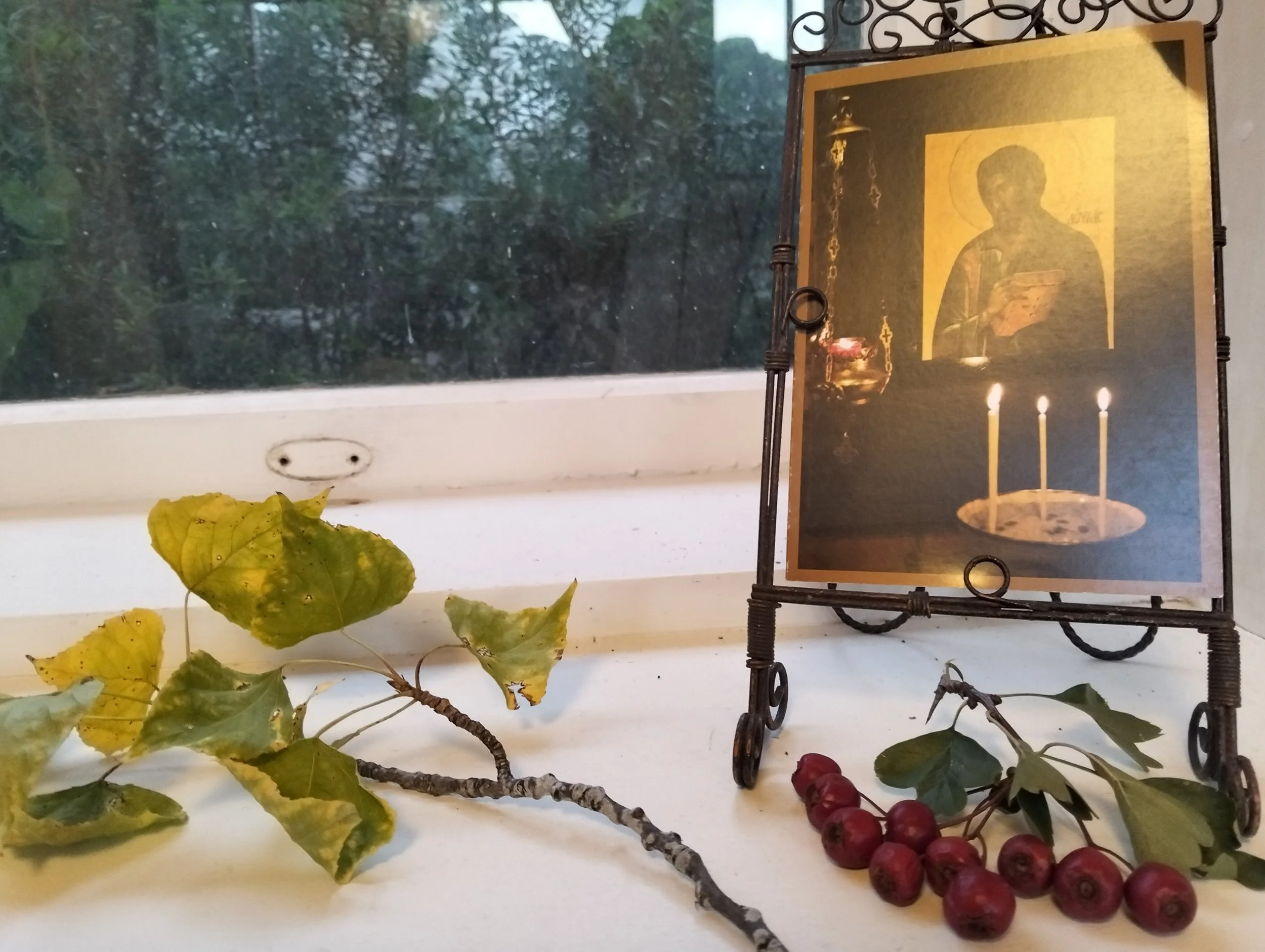
Our group is meeting as day turns into dusk. We meet via Zoom as our members are spread out over the country. I have the computer in front of me with these little stamps of peoples’ faces on it. They move, talk, and are sort of here.
To my right, windows out onto the valley: A hill I call The Wave, like Hokusai’s “The Great Wave off Kanagawa.” Poplars beginning to gold and bleach. Some oaks, by St Cuthbert’s, fringed with red and orange.
The air is cool and still. It is autumn.
After about thirty minutes of silent waiting, I’m lifted out of a frothy, tired state. Suddenly, I become quieter, clearer, and more peaceful.
The quiet deepens outside, too, like all the birds have stopped singing. It is dusk.
We finish our meditation and break for fifteen minutes. I open A New Zealand Prayer Book:
Christ is the image of the invisible God / the first-born of all creation.
In silence and stillness, feeling clear and refreshed, I am in a position to more fully receive these words. They are strange, beckoning, clear. I am reading them as if for the very first time.
In him all things in heaven and on earth were created: / all that is seen and all that is unseen…
He exists before everything / and all things are held together in him.
I am reading with ‘beginner’s mind’, or what the contemplative tradition might call the ‘contemplative mind’. What Quakers call ‘simplicity’. I am reading the words for the very first time *and* once again.
I have a memory of some retreat time spent at Waianakarua, North Otago. Each evening, at dusk, the birds would sing their evening prayers, beginning, punctuated, and ended by the tui.
And it really puzzled me, it woke me up! What are the birds saying? It seems like they are saying something. That they keep on saying - or singing - something every day.
Suddenly, it occurred to me: they are singing Day, Day, Day is over! They are calling down the day. This day, to-day, but also Day. They are remembering the very first day of creation, which is also here and now.
In a few weeks, it will be Holy Week and the pinnacle of the Christian year: the Easter Vigil Night service. The whole sweep of scripture will be read, beginning with the very first day and then on up to the “first-born”.
I call the Easter Vigil, ‘Christianity in a nutshell’. It’s a long, dramatic service in both Roman Catholic and Anglican traditions. We begin outside in darkness with the new paschal candle being lit from a brazier. It is autumn.
We process into the dark church, following the Paschal flame, holding little candles ourselves.
The priest sings, in a bell-like manner: Christ the Light!
And we reply: Thanks be to God!
And then the thundering silence of the church, Earth waiting.
We take our places. The priest begins singing the Exsultet. As soon as I hear the first notes and words - Rejoice now, heavenly hosts and choirs of angels - my heart breaks open. I am home.
Here’s those opening lines in the Roman Catholic version (the lines are slightly different, but the tune is the same):
Christianity needs mystery, is mystery. I need mystery, am mystery.
The Anglican Church needs mystery, is mystery.
We can’t hold our vital “Anglican comprehensiveness” together with rational minds alone.
We certainly need “sound learning”: the Anglican Church as a “strikingly balanced witness to Gospel and Church and sound learning” (1), but we need, I need, access to a deeper mind, one that is characterized by wholeness, simplicity, and peace. It is the perennial witness of the contemplative tradition that such a mind is the mind of Christ - and is the same mind that wrote, or inspired, the scriptures.
I have been reading The Anglican Spirit, a book of introductory lectures to new ordinands at Nashotah House by the former Archbishop of Canterbury, Michael Ramsey. It’s the single best introduction to the Anglican tradition that I have, as of yet, found.
We are led, warmly and wisely, through the early period, the separation with Rome, the early reformers, the Anglican balance of scripture, reason, and tradition, and the interest of the Anglican divines in antiquity and the church fathers. We are led through Tractarian and Liberal Catholic controversies and contributions. We meet John Henry Newman, Charles Gore, and William Temple. Yes, it is a somewhat Anglo-Catholic tour of the province! No one has the complete answer, and no one is rejected outright. Ramsey has opinions, but is broad and irenic. We come to the more recent period concerning biblical scholarship, Christian renewal, the theology of the church, and Anglican relationships with the Roman Catholic and Orthodox Churches.
It’s so readable because it’s personal - spoken lectures from a man who has spent his whole life soaking in, clarifying, and navigating the Anglican tradition.
And who practised a deep life of prayer and worship. And who wrote a short, serene guide on “the life of prayer” - Be still and know (1982). And yet…
I wish Ramsey had taken these words - be still and know - and placed them at the heart of The Anglican Spirit (perhaps taking a leaf out of the Orthodox approach to church and theology). Or: I wish Ramsey had made the relationship of his prayer life to his understanding and presentation of theology and the church more explicit.
Yes, at the beginning of The Anglican Spirit, Ramsey notes the centrality of worship and common prayer to Anglican theology and formation:
…the Anglican settlement as now defined had not only a confession, a set of articles, but also a Prayer Book. It is this foundation that was, and remains, so very characteristic of the Anglican paradosis. And it is true to say that while there are churches in Christendom where, when you ask, “Now tell us what you stand for?” they will say, “Well here are our articles, that is what we stand for”, it has always been characteristic of Anglicans to reply, “Yes, here are our articles, but here is our Prayer Book as well - come and pray with us, come and worship with us, and that is how you will understand what we stand for.” (2)
Unfortunately, the importance of prayer is left here, as a beginning and foundational statement, rather than followed as a central thread through subsequent chapters and figures, or reflected upon in terms of its development over time, or returned to as a way of holding together and discerning all the parts.
For example, how does prayer (broadly conceived) enable us to hold the whole paradosis - catholic, reformed, and reforming - together, with simplicity, authenticity, and peace?
Yes, there’s emphasis on the importance of mystery for Hooker. (3) But, again, this aspect is mentioned, and then we’re off.
There’s a moment in The Anglican Spirit where Ramsey discusses Newman’s approach to certain theological controversies, such as justification. He says:
Newman protests against those who make a doctrine of “justification by faith” itself an object of faith, so that instead of believing in Christ who justifies, one believes in the doctrine. (4)
As Newman himself writes:
True faith is what may be called colourless, like air or water; it is a medium through which the soul sees Christ… (5)

Common oak outside St Peter’s, Teddington
This Lent, I am repenting despair and hopelessness for the church. I have been praying for some church members, clergy as well as laity, with whom I have had conflict and a rupture of relationship. I throw in some members of my family, too, who are sadly estranged from me, and, of course, end up praying for my wife and kids and myself. And some other friends. And Iran!
I realize that everyone, in their own way, is full up to the brim with stress.
A client speaks of being yelled at in a shop by someone he doesn’t know, after making a very simple request.
The world is full up to the brim with stress. The water is right up to our nostrils, and the tiniest of increases results in us beginning to panic, and to behave in panicked ways.
As is well known, the Anglican Communion is bitterly divided concerning same-sex relationships and the church. The “Inter-Anglican Standing Commission on Unity, Faith and Order” thus writes:
Our present disputes centre on what a holy life looks like and at the same time present an opportunity to engage one another in as holy and godly a way as possible. (6)
Christ - the mind of Christ - holds the church together:
He is the head of the body, the Church…
And more, much more than that:
He exists before everything / and all things are held together in him.
There is the immersion of contemplation - encountering our resistance, going into silence, encountering the heart of silence, encountering our exhaustion, needs, and wounds; there is the therapeutic alchemy of contemplation - becoming still, gathered, enlivened, and refreshed; there is the return and practice of contemplation within the world - reading one’s prayer book or the scriptures, asking for forgiveness, finding the energy to get up for the kids in the night (and then work the next day), with the life and the love more full inside, with an awareness of the Presence a little clearer.
There is the discovery that the world and contemplation are one.
Unless I am engaged, regularly, in such a practice - seeking/finding union with Christ in the Spirit - Christianity, including Anglican Christianity, is just too hard.
But I would also be missing out on Christian maturity, or maturation - what is doctrinally known (to some) as sanctification, or, more simply, salvation as a process, “growing in grace” - an encounter through which real, open-ended transformation silently, gradually occurs.
It is dark again outside. Ragged clouds blow over The Wave.
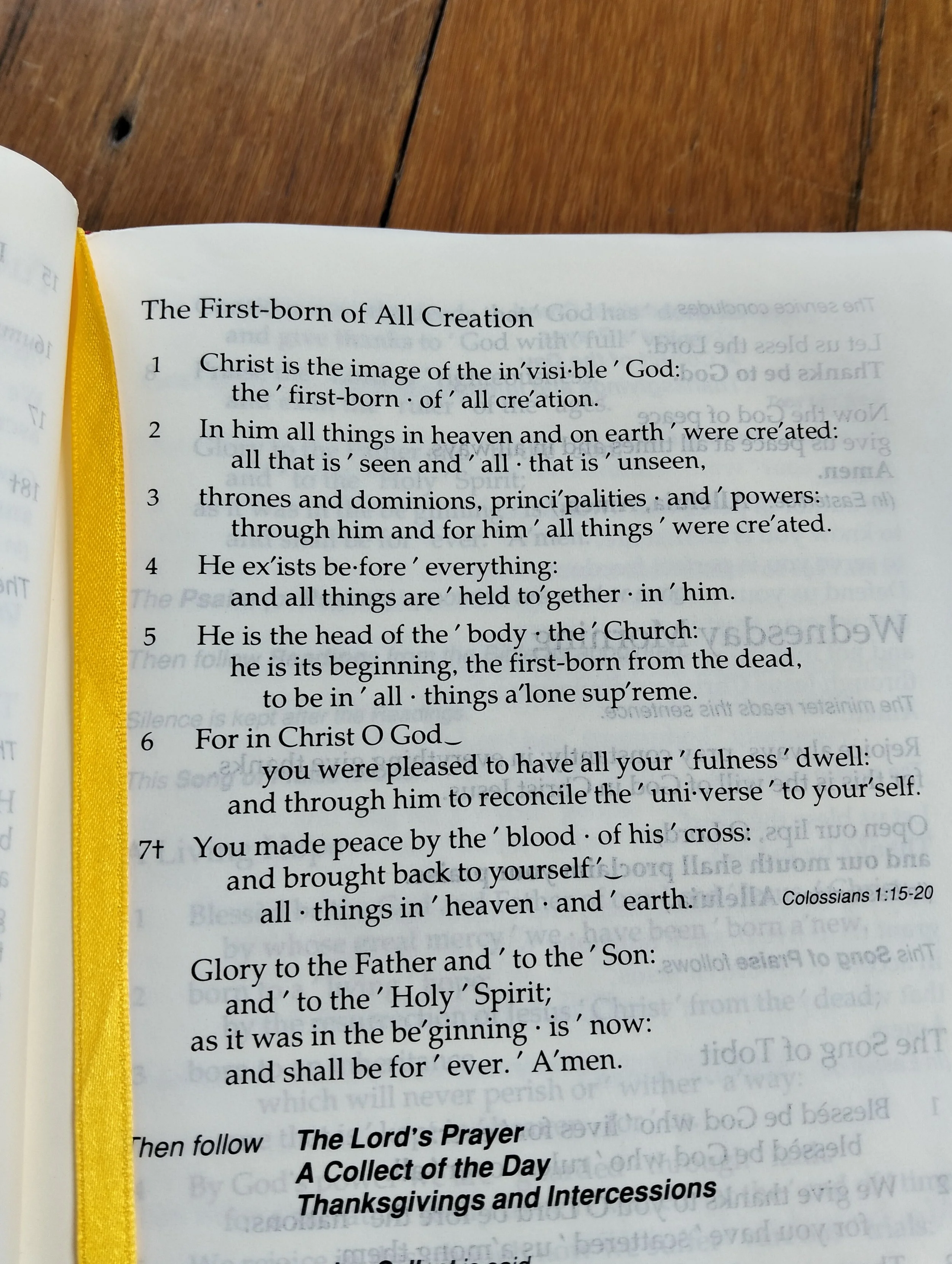
Page 73 from A New Zealand Prayer Book (2005 edition)
References
(1) Michael Ramsey, The Gospel and the Catholic Church, (originally published 1936; 1989 edition), p.220.
(2) Michael Ramsey, The Anglican Spirit (1991), p.18.
(3) Ramsey, The Anglican Spirit, p.20.
(4) Michael Ramsey, The Anglican Spirit, p.59.
(5) John Henry Newman, Lectures on Justification (1838), p.336.
(6) Supplement to The Nairobi-Cairo Proposals (Rome, 2025) by the Inter-Anglican Standing Commission on Unity, Faith and Order, retrieved from https://anglicandownunder.blogspot.com/2026/03/whither-anglican-communion-revised-new.html