God beyond God
(1.
So, Burnout Christianity…
So many people in need of saving!
Our family living in the suburbs of Bombay, India. My father scooping up the bones of almost-dead people on the pavement in front of our compound, taking them to the home of the Little Sisters for a more dignified death.
My parents telling their missionary board in India that they were out of town, at a religious conference, when, really, they’d booked a hotel room on the other side of Bombay, just for a break from the grind of work and poverty.
Missionaries, without roots in the land, without belonging or defensible personal needs. Their reason-for-being as a being-for-others, being to save souls, to win souls for Jesus and his kingdom. In practice, saving bodies from poverty and early death. My grandfather (fifty years in India) as the de-facto local dentist, concrete layer, panther shooter, and pharmacist (he was trained as a mechanic, and only partially as a minister). My grandmother, literary and capable, the local pharmacist, doctor, and midwife - living on call to rural India. Loved and valued. Dying early, with the body of a woman twenty years older than hers.
My mother’s first “house” beside the public latrines in Bhor. Babies in hanging cots, to evade the rats and scorpions. Her second “house”, which her father had converted and upgraded, previously a large shed for pigeons.
My grandfather, warm and lovable, a law unto himself, falling deeply in love with India and its people. Changing his missionary faith. Confounding church authorities back in NZ.
My mother being placed on a train when only five, sent to the south of India for boarding school. Sent on a boat to Australia for secondary school. My grandmother struck silent, ashen-faced with grief.
My Dad, martyred at a young age, by choice, becoming a Catholic priest and missionary father. Yearning for love and eventually, thank God, handing back his “gift” of celibacy and ordination.
Coming to New Zealand, finally having a house of their own.
My mother, bullied out of a job by a colleague. My father and Uncle urge her to defend herself. She folds and leaves. Later, she says: That was a very painful time, but the beautiful thing is I got to experience what our Lord must have experienced when he was wrongly accused, and didn’t say a word....
Suspending ourselves to be interested in others, to host others, to give others the (psychological) shirt of our backs. Crashing into exhaustion when the others finally leave.
Christ on the cross, nailed to the cross, the eternal cross: never leaving the cross until the last being is saved.
Jesus will be in agony even to the end of the world. We must not sleep during that time. (Blaise Pascal).
Burnout Christianity in intellectual forms:
‘Mastering’ two thousand years of scripture, church history, theology, pastoral care, apologetics, knowledge of culture and human societies, human sexuality, parish finances and management, endless etc.
Studying days and nights, giving up weekends, suspending the self.
Is Burnout Christianity just “Christianity?” Is there a more balanced, life-affirming “true version”? Is Christianity capable of being saved?
And there it is again: Become a saviour. Master a better “system”. Save (new) souls as a (progressive, enlightened) priest, a psychotherapist.
Is it not the work of God alone to save souls?
And don’t I believe in ‘synergism’ (“working together”)? That each person has a responsibility to participate with the Divine in their own healing, ‘salvation’, and growth?
Having formal knowledge to counter the pathological, lop-sided pattern, but the seed is deeply unconscious within.
2.
Of course, Burnout Christianity isn’t wholly bad. And it’s not the whole reality of, say, my family’s involvement in India, my father’s time as a priest, my own career as a psychotherapist, etc.
It’s my name for the shadow of a light. A bright light casts a big shadow, as Jung observed. The villagers in Bhor District got better wells, less plague. My grandfather had the adventure of his life (twice driving across the European-Asian continent, from London to India, through Europe, Turkey, Iran, Afghanistan, etc.). My father realized his dream of becoming a priest and had the great privilege of administering the sacraments to many. Such a richness and a privilege in studying sacred tradition. My mother comes alive when in India: is full of vitality. My family had the great privilege of serving God in India, of meeting so many, of loving so many. India is deep within our family’s heart.
We brought these riches back to our life in New Zealand, and we also brought the shadow of the light back, too.
Christianity has a poor track record of accepting and working with its shadow.
On one level, Burnout Christianity is sort of spiritually/energetically inverted: it asks us to forgive others, heal others, before we’ve had “our daily bread”. (see Matthew 6: 9-13). It demands we attend to the souls and health of others before we have fully received the Holy Life-Breath - abundant life -and been reborn or renewed in ‘the power’ and ‘the truth’. It asks us to accept and internalize others’ (authorities’, religious heroes’) experience of what God is saying, what God is calling us to be and to act, often under considerable emotional and collective pressure, without adequate space for our own discernment. This is where the Quaker way has been so helpful in my “recovery” as a Christian (although Quakers are prone to invert contemplation and service, too, so to speak).
Seek ye first the kingdom…the better part.
3.
1n 1952, Paul Tillich wrote a book called The Courage to Be. He spoke of the need to “transcend theism” - to move beyond belief in God as “a being”; crudely, a literal Father or King, an old man in the sky, ‘the Lord’; philosophically, a divine being whose existence can be proved or disproved. Instead of God as a being or supreme being, Tillich spoke of the God beyond God: Being itself, the ground or power of being.
He writes:
Absolute faith, or the state of being grasped by the God beyond God, is not a state which appears beside other states of the mind. It never is something separated and definite, an event which could be isolated and described. It is always a movement in, with, and under other states of mind. It is the situation on the boundary of man’s possibilities. It is the boundary. Therefore it is both the courage of despair and the courage in and above every courage. It is not a place where one can live, it is without the safety of words and concepts, it is without a name, a church, a cult, a theology. But it is moving in the depth of all of them. It is the power of being, in which they participate and of which they are fragmentary expressions. (1)
This passage is very rich, and points me to another way through the impasse of ‘Burnout Christianity’ (in addition to the above comments about energy, discernment, and synergism). It offers us a way forward that doesn’t involve constructing and submitting ourselves (conforming) to a new, better system - “true Christianity, rediscovered”! How many reformations, awakenings, and theological renewals have attempted and promised just that, only to become...
What Tillich offers is not a new religion or theology, but a new attitude or way of being religious (once again). He acknowledges religious language as inherently symbolic, but doesn’t stop there. He speaks to our potential for personal encounter - under and within all religious symbols and language - with that which is infinite and unconditional.
Symbols are to be seen and seen through. (2). Mature religious practice involves both. In what Paul Ricoeur calls “the first naïveté”, or the first movement of faith, we don’t see symbols as symbols but “simply receive them as transparent windows into the sacred”. (3). A “priest” is seen as the spiritual authority, the man up front who is in charge. As we get older, we learn what the church teaches about the symbolism of priests - that they represent Christ on our behalf, and that is why they must be celibate and male.
In the second movement of faith, “critical distance” or “the hermeneutics of suspicion”, religious symbols and texts are deconstructed in critical analysis. We discover that the English word “priest” translates at least two Biblical words with different histories and meanings: presbyter (“one with elderhood”), and ‘priest’ (hiereus, “sacred one”). We discover that the tradition of unmarried, celibate ‘priests’ is a later, distinctly Roman Catholic one. We explore the ways that this particular interpretation justifies certain people and oppressive power structures (patriarchy). And we may hear how non-Catholic Christians, say Quakers, have used various Biblical texts (Joel 2:28; Jeremiah 31:31-34; John 3:3-10; John 4:19-24; 1 Peter 2:9) to articulate a ‘church’ without formal clergy, or, rather, to establish a ‘priesthood of all believers’, including women.
There is a fairly obvious danger in getting stuck in at the first naïveté - the danger inherent in all Biblical literalism and religious fundamentalism. But there is also danger in being stuck at the second stage, too: we become overly intellectual and critical in our faith. Religion becomes dry, enormously left-brained. We read the following words with astonishment and sorrow:
It is not the task of Christianity to provide easy answers to every question, but to make us progressively aware of a mystery. God is not so much the object of our knowledge as the cause of our wonder. (4)
Beyond the desert of criticism, we wish to be called again. (5)
This is what Ricoeur calls “the second naïveté”, a place beyond “the desert of criticism”; a “post-critical” faith that acknowledges rational critique, symbolic indeterminacy and plural meanings, and yet still allows for poetic, transformative ‘religious experience’.
I experience an old man who falls asleep in a silent Quaker meeting as a priest - in the sense of mediating the divine presence to me. I see him asleep, “resting in God”. It softens my effortful striving. I begin to wonder how my children are mediating God to me at home.
While in some ways consciously situated at the “post-critical” stage, in his comments on “absolute faith”, Tillich is speaking of an encounter that is beyond or under all stages. We are “grasped”, to use his language, by a power that is more than us, in “a place”, “a boundary”, “a movement…without the safety of words and concepts…without a name, a church, a cult, a theology…”, and yet “…moving in the depth…” of them all.
It is an encounter in which our self is mysteriously affirmed - rather than sacrificed, denied, or abandoned. We feel profoundly accepted by that which is infinite, loving, and most real. We are “confirmed” in our very essence by the power of being itself. (6).
Crucially, Tillich believes this encounter involves the courage to accept acceptance (what Christian theology has traditionally called ‘justification by faith’). This gives us both the courage to be a part (of a whole) and the courage to be oneself, without losing one self in conformity, meaninglessness, depersonalization, anxiety, and the fear of non-being. For Tillich, with his deep roots in the Lutheran tradition, the concrete religious symbols for this are the crucified one and the cross.
To despair, let go, to encounter the infinite Ground of Being; to lose our former life and (religious) identity, and yet be confirmed in our inmost being and ‘world’:
But a church which raises itself in its message and its devotion to the God above the God of theism without losing its concrete symbols can mediate a courage which takes doubt and meaninglessness into itself. It is the Church under the Cross which alone can do this, the Church which preaches the Crucified who cried to God who remained his God after the God of confidence had left him in the darkness of doubt and meaninglessness. To be part in such a church is to receive a courage to be in which one cannot lose one’s self and in which one receives one’s world. (7)
4.
It is Holy Week, Maundy Thursday. On the spur of the moment, I decide to attend a traditionally Anglo-Catholic church. I walk through the door and instinctively look for a little basin of water at the side. There is one! I dip my hand in and make the sign of the cross. I’ve never found these little basins of water - holy water fonts or stoups - since my Roman Catholic days. I keep looking in every Anglican church I step into.
My head is dripping water, and now I smell the church. Ah, it is a church - made of wood and stone and vaulted space. It is a church, not a modern lounge or theatre.
The service is solemn and moving. It has melodies that open my heart. There is space.
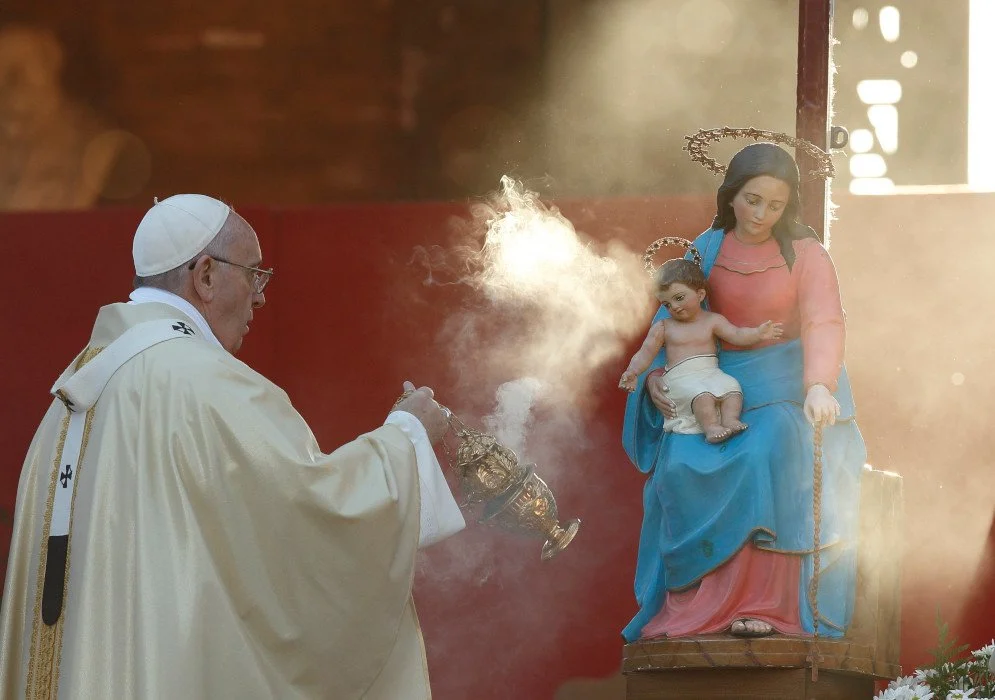
There is so much frankincense! I would come back just for this. I’ll agree to say anything, believe anything, just as long as you give me my sweet, holy smoke!
And there are things I dislike and tolerate: the sheer distance of the clergy from the parishioners. The lack of warmth when I share the sign of peace with others nearby. The constant Almighty Father for God.
Afterwards, I think: Gosh, I’ve been yearning for this, without fully knowing, for a very long time. I am so Catholic in my blood. It will never leave me and will always call me home - just one sound or smell is all it takes. At the same time, I’m happy being Quaker, too. We are a queer people. We renounce all this beauty and these sacred, luminous forms, and meet in some quite ugly buildings. But we love each other (on the whole), value freedom, and allow any one of us to stand up and speak, if the Spirit moves. And we often feel the power of being moving amongst us.
I go home, go to bed, fall asleep, and dream: there is a spirit inside me, moving forward, and a spirit beyond me, approaching.
References and credits
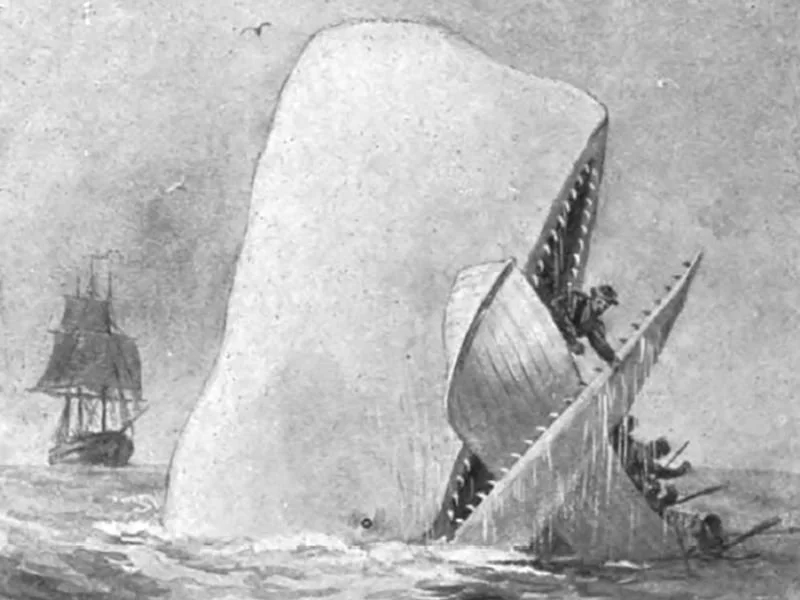
First image: An illustration of Moby Dick attacking a whaling ship. Augustus Burnham Shute from the Moby-Dick edition published by C. H. Simonds Co.
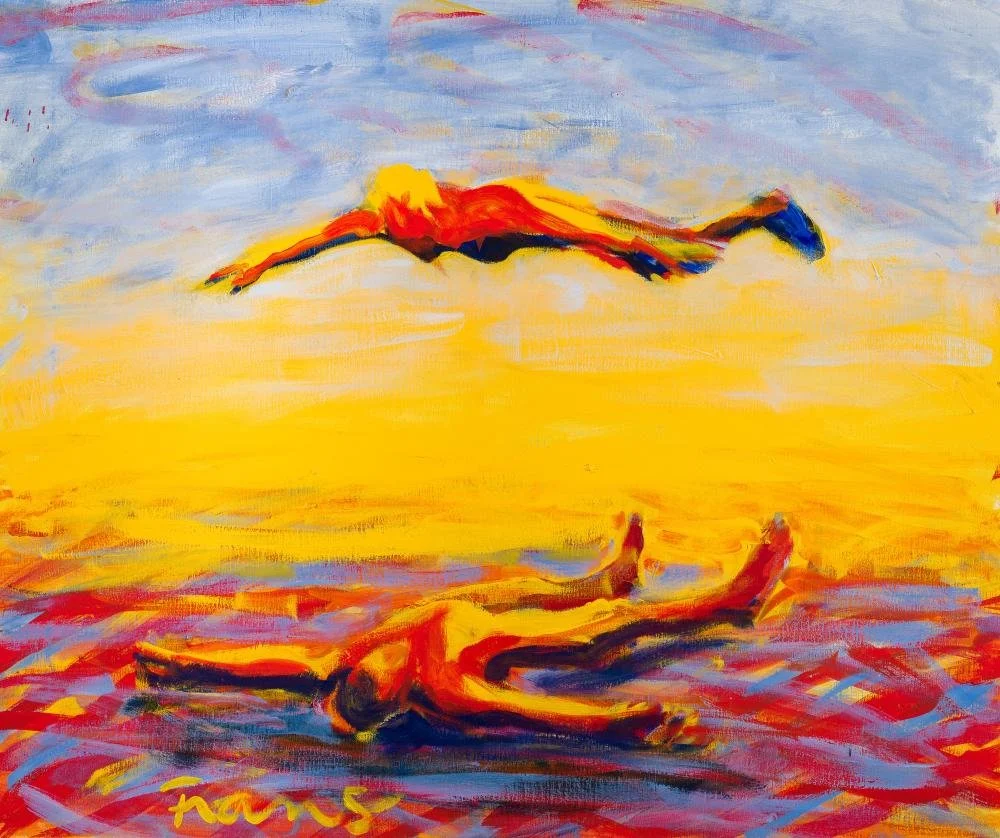
Second image: Frans Widerberg, Hovering and Lying.
Third image: Pope Francis uses incense as he venerates a statue of Mary during Mass in Verano cemetery in Rome, Nov. 1, 2015.
(1) Paul Tillich, The Courage to Be (1952), p.182.
(2) Mark Reynolds, “Faith After Doubt: Paul Ricoeur’s Second Naïveté and the Journey Toward Mature Belief”, 2025.
(3) Reynolds, above.
(4) Kallistos Ware, The Orthodox Way (2018).
(5) Paul Ricoeur, The Symbolism of Evil (1967), p.349.
(6) I am thinking about the word “confirmed” in the sense that Martin Buber used it, as the basic affirmation of our personhood in dialogical relationship with the other. See Martin Buber, “Dialogue” (929), in Martin Buber, Between Man and Man, translated by Ronald Gregor-Smith (first published 1947). “Confirmation means confirming the uniqueness of the other person by making the other present through “inclusion”…Knowing that we are made present by the other in what we are and what we are called to become induces the inmost becoming of the self”; Tamar Kron and Maurice Friedman, “Problems of Confirmation in Psychotherapy”, Journal of Humanistic Psychology, Vol.34, Issue 1, 1994..
(7) Tillich, The Courage to Be, p.182.