Was Jesus concerned with ‘the inner’?
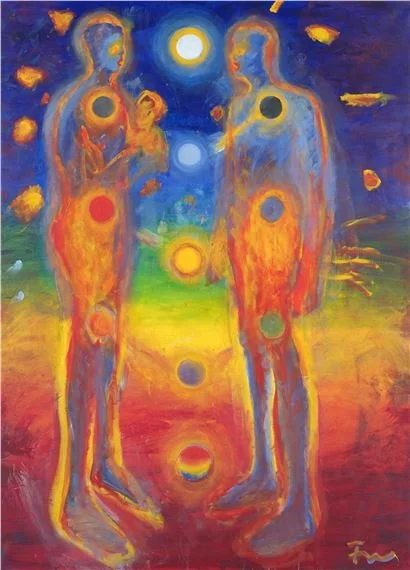
Frans Widerberg, Livstreet 1993-1994
1.
This post is written with Quakers in mind, but perhaps others might listen in and get something out of it, too.
I recently attended a Meeting for Worship (Quaker service) in which an extract was read out concerning how Jesus conducted himself and taught, and how we, as Quakers, should conduct ourself too and ‘search’ for God (or not).
The extract came from a recent Aotearoa New Zealand collection of Quaker faith and practice called On These Islands (see below).
Perhaps it was included to show the diversity of Quaker opinion in this part of the world, or perhaps the editors of the book were making some other point - that Quakers have been far too concerned with ‘the inner’ and the inner search for God, and we should just get on with living life and find God in the midst of our community, social service, and engagement with life.
I had just attended and presented at a Quaker seminar on the topic of Who, What, Where is God? I was feeling rather full and dazed. When the extract was read out I could barely believe what I was hearing. A Quaker wrote this? Really? Why is this being read out here and now?
My response was to feel angry and outraged. That’s not usual for me but is tricky to handle in the context of a silent waiting on the spirit, which generally is a movement into greater depth, stillness, and a sense of love and oneness with one’s fellow worshipers.
One of my reflections from the weekend is that the Light in Quaker spirituality and Christian mysticism in general is often leading us into whole-making, into greater harmonization of the many and often warring parts (inner and outer) that we are. In contemporary spiritual language, the truest light shines as non-duality, as oneness.
And then there is the phenomenal world.
God says Let there be light! at the start of Genesis. This form of light ushers in a strange sort of light and dark, night and day. This light comes before the creation of sun, moon, and stars, so what sort of oscillating rhythm of night and day is it creating?
For me it is the world of duality, the play of opposites that are a part of living in the phenomenal world. This also happens when Adam and Eve eat the fruit of the Tree of the Knowledge of Good and Evil. They are thrown out of paradise - oneness with God, reality, and each other - and have to contend with struggle.
This is a developmental achievement and a curse: we separate from our parents and from our early oneness with ‘the dynamic ground’, as Michael Washburn put it, with the unconscious Ground of Being, with God-consciousness, with our body (in some sense), and enter the world of differentiation, struggle, otherness and encounter. We develop our ego - or ‘separate self sense’ - as we differentiate and become the persons we are meant to become.
But then we must reunite with the Ground once more - perhaps in moments of crisis, in our search for deeper meaning and healing, or as we enter the descending arc of ‘the second half of life’ - in order to become the people we were truly meant to be and are. And this is the point of true spirituality - to lead us back into oneness.
The greatest light is the one that shines beyond light and dark.
When you make the two into one, and when you make the inner like the outer and the outer like the inner, and the upper like the lower, and when you make male and female into a single one, so that the male will not be male and the female not be female…then you will enter the Kingdom.
- Jesus, The Gospel of Thomas
And yet we must still live in the world of duality, or we simply do, and this is part of our existence, our oneness, as well. As Richard Rohr points out, Jesus, both truly human and truly divine, lived in both worlds and speaks to us in the language of both worlds, too.
Jesus often used the language of duality: goats and sheep, salt and light, being born of water and being born of the spirit. But ultimately, like all great spiritual teachers, his highest teaching is that of unity, harmony, wholeness, non-duality, unconditional love: I and the Father are one, may you be one with me and the Father too. May all my disciples be one, one in the Spirit, one with each other.
Christian theology and scripture has many names for this ultimate oneness: incarnation, resurrection (when referring to Jesus), regeneration, theosis, one in Christ (when referring to us).
The Gospel of Thomas is Jesus’ teaching on oneness, par excellence.
So I’m burning with anger in Quaker meeting and thinking, What do I do with this? I’m pulled into the world of opposites again: inner versus outer, light and dark. O how unspiritual and disappointing, Mark! Is it ok to be angry and offer ministry from this place, knowing it will be rather partial and incomplete? I cannot say nothing! Or do I wait until I cool down and become ‘more spiritual’ (!).
I decide to speak, that sometimes we must take up the part we have to play in the world of opposites, the world of duality, knowing that a fuller truth will emerge later on.
That anger is a part of wholeness, can be a creative part of whole-making, though initially it causes rather sharp and forceful differentiations of ‘the field’.
I give a partial, incomplete, angry ministry. It’s not very good, but perhaps others will offer a fuller, more embracing perspective - and one that also holds the person who read out the extract (who I like very much!) and me and my existence as well.
Later, at home, I sit in the Light with this “concern”. I cool down, somewhat, and write a response to the extract that was read out.
Quakers have a testimony to truth (“truth”, “integrity”). An early name for the Society was “Friends of the Truth”. We have a testimony to seek and speak the truth. Yet we also know, as Isaac Pennington so crisply put it in 1653:
All Truth is a shadow except the last, except the utmost; yet every Truth is true in its kind.
2.
So here is the extract that was read out:
The last thing you should do in Meeting for Worship is to think about yourself. That way lies madness. If there is a God to be found by Quaker worship he/she is accidental to seeking. Jesus made it quite clear: “Anyone who tries to save his/her life will lose it, and “Seek the Kingdom of Heaven”.
What is this Kingdom? Watch Jesus, who lived in it, and see what he did. Not a single case of him encouraging anyone to look ‘inward’, not a single case of him searching his own soul. He ate and drank with anyone, regardless of rank, or sex, or nationality, or race, or religion or holiness and he healed when asked to, and he was faithful to his message of universal loving until he was killed for it.
So let us go on doing things together – eating, planning, acting to heal every sort of hurt we can. That way we reach towards God, who is merciful and righteous, or towards God-likeness.
- Llyn Richards, 2003, in On These Islands, 3.39.
And my response:
Of course Jesus was concerned with the inner! Time and again, he asks people to look within, at the quality of their heart, rather than focus on external compliance with the law, the Torah.
When asked how to pray, how to meet and be in communion with God, Jesus said: go into your secret room, close the door, and pray to God ‘in secret’.
Jesus often retreated from ‘public life’ – from the crowds, from those seeking his company and presence, and even from his followers and close friends – in order to be with God and pray. He would go off into the hills, on mountain tops, to “lonely, solitary places” to be with God and pray.
Of course, Jesus ministered to people – healing, teaching, eating and drinking – and seemed to have a direct, easy way with many of the people he encountered, especially those on the edge of, or outside of, the Jewish religious system. But to renew his spirit, and especially before decisive moments in his life and ministry, he would withdraw, go within.
He taught that the kingdom of heaven was “within you” (or “in our midst”), and that we could only enter it through being born through both water and spirit – that is, born physically and re-born again through the Spirit, in an inward, invisible, vital sense. He taught that the truest, deepest form of worship was not worshiping in temples and on mountains – that is, externally – but a future in which people worshiped God “in spirit and in truth”.
If Jesus hadn’t said and taught these things, and acted in these ways, we probably would never have had a Quaker movement.
Fox and early Quakers were energetic, lively people who mixed with others in loving and challenging ways. But the core of the Quaker spiritual testimony is that the Spirit is to be encountered within. The Teacher is within. Christ is within. When we heal and renew ourselves through this deep encounter, then we have more peace and energy to engage with the world of others without burning out (or burning out even more).
I reacted so strongly to this extract because I care deeply about truth – the truth of what Jesus said and did, and the truth of the Quaker tradition. But more personally than that, through much of my childhood and early adulthood I heard the message that thinking of yourself is bad, is spiritual “madness” (as Llyn Richards puts it), and is contrary to the self-sacrificing way of Jesus and of the Gospel. I’ve seen and experienced how abusive this message is – in my life, in the life of family members, and with many clients I have worked with in therapy over the year.
We don’t have to trash ourselves, we don’t have to give ourselves over completely to the needs of others, we don’t have to trash our Quaker distinctiveness, in order to seek God and live a balanced life.
Mark Crozier Murphy, September 2026