God as love: an inclusive-language, trinitarian invocation
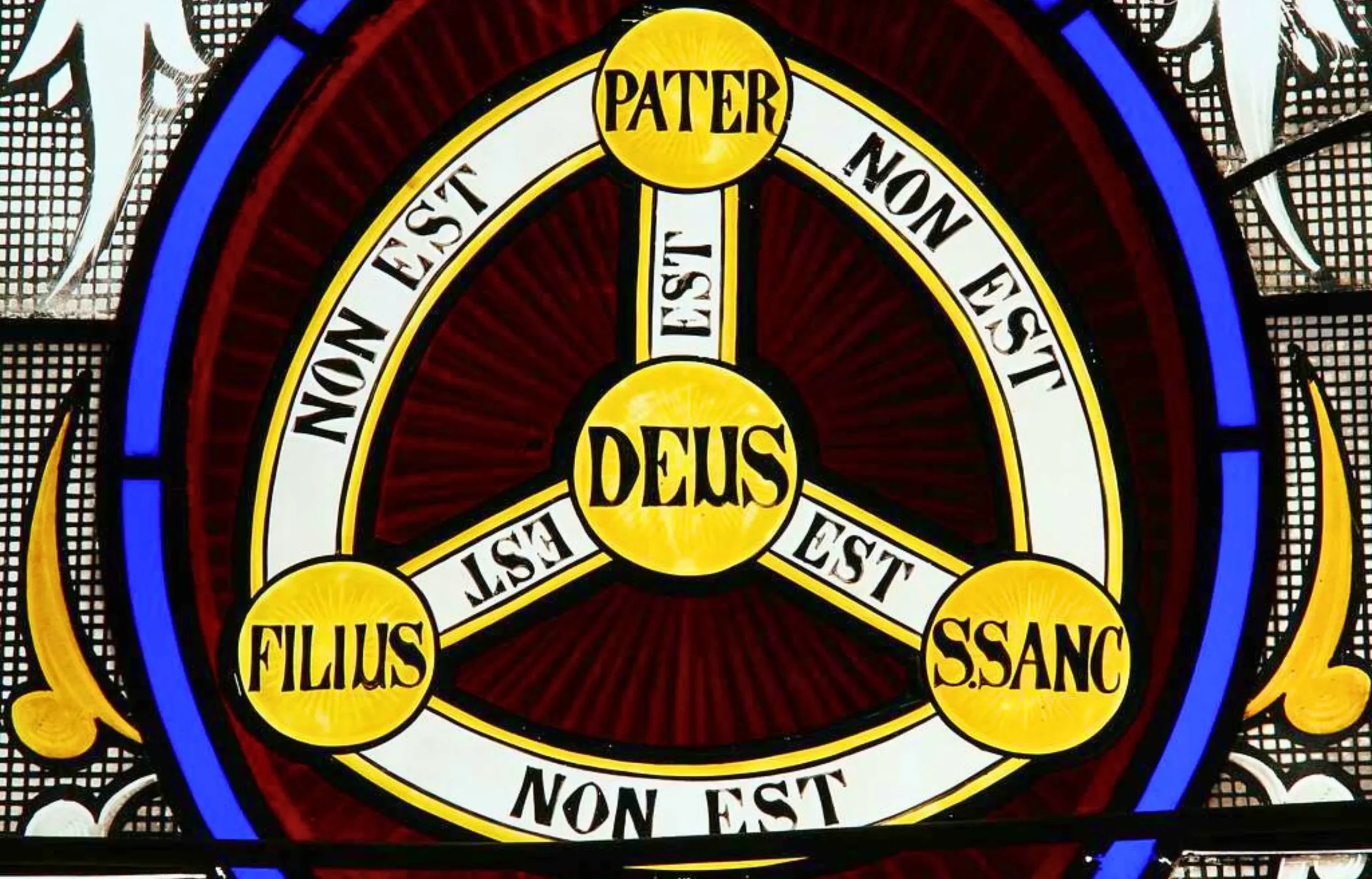
Can we find an inclusive-language way of speaking about and invoking God as Trinity? Is such a search even theologically legitimate? Can we find an inclusive way that is appropriate for liturgical use?
Understandably, many, if not most, Christians may wish to keep with the more traditional, trinitarian invocation:
In the name of the Father, the Son, and the Holy Spirit, Amen.
This phrase has clear scriptural basis in the words and commandment of Jesus (1):
Go therefore and make disciples of all nations, baptizing them in the name of the Father and of the Son and of the Holy Spirit. (Matthew 28:19).
It is important to remember that Jesus was speaking to a particular audience - to those living in first century Palestine, and particularly those oppressed by both Roman rule and an exclusive, priestly system. Our task is to discern what is core to his words and Gospel message - for example, is it the fundamental masculinity of God, or that the Creator of the universe is actively working to save and liberate the poor, blind, and the broken? - as we seek to interpret those words anew, and speak to contemporary people and needs.
But before we venture into critical theology, let us affirm in addition to its harmony with the words of Jesus, that the traditional trinitarian invocation has also been used for countless generations - by the early church, and the medieval and modern church, in its prayers, creeds, sacraments, and liturgies. These are the sacred words that I was brought up with, too, and for most of us are seated deep within our souls.
If I were called on to perform an “emergency baptism” (!), I would instinctively say, no doubt:
I baptize you in the name of the Father and the Son and the Holy Spirit.
For all these reasons, we should possibly just leave things as they are and not ‘meddle’ in complex, fundamental theology.
In the name of the Father, the Son, and the Holy Spirit is short, memorable, the words of Jesus himself, and has been used by countless generations. Above all, perhaps, these words are a deeply personal and relational way of addressing the Divine Mystery and Source of our lives. If our liturgy and prayers are about moving closer to God, becoming one with God, loving God with all our ‘heart, soul, mind, and strength’ (Mark 12:30), then our language must resonate on the level of our hearts and connect us with God’s heart (and each other's hearts), too.
Theologically speaking, the traditional invocation of the Father, the Son, and the Holy Spirit affirms God’s oneness while simultaneously affirming the analogy of three, undivided “persons”. There are numeorous pitfalls in navigating this terrain, as the famous “Shield of the Trinity” makes clear…
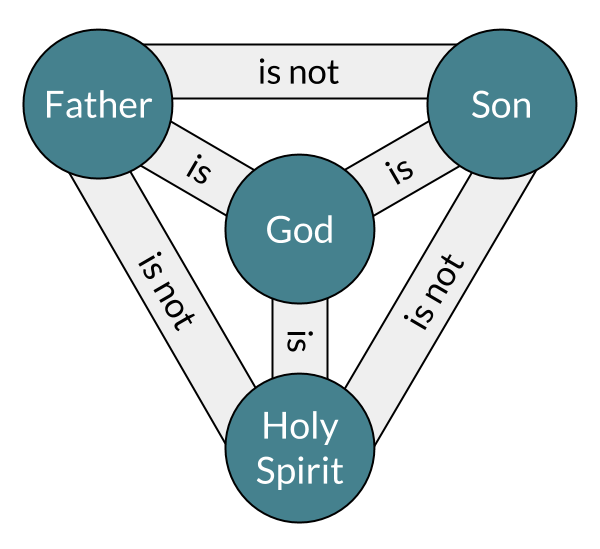
So perhaps we should just leave it here. The pitfalls are great, too great. And to change, or attempt to update, the words of this classic Christian formulation/invocation could result in an unnecessary rift and conflict in the Body of Christ. But that is making the very big assumption that all is well and good in the Body of Christ, generally and presently.
The problem with “just leaving it here”, of course, is that the traditional trinitarian phrase - the Father, the Son, and the Holy Spirit - skews towards affirming God as male, or, rather (allowing for neutral language regarding the Holy Spirit) affirms that God is mostly male, mostly masculine. Fundamentally, this limits the truth about God.
For God, the divine source and lover of all that is, is beyond gender; inclusive of, but beyond our limited gender categories, and certainly beyond being imagined and spoken of as mostly masculine.
God is much bigger - more vast and glorious - than we are able to think and name. As The Cloud of Unknowing puts it, “by love God can be caught and held, but by thinking never.” (2). When pushed - by our natural human curiosity and demand to know - the most God gives us is: I AM WHO I AM (Exodus 3:14).
We know God is more than masculine, or mostly masculine. We know any attempt to speak of God must eventually take us into silence, into a wordless all-consuming love. Nevertheless, we need to find a more inclusive sacred poetry as a bridge into that silence and genuine peace - especially since the human condition (including its socio-political dimension) is urgently bound up with the divine (as the doctrine of the incarnation emphasizes).
This is also an issue of doing justice to the breadth and wholeness of Catholic faith, which indeed is overflowing with many rich, varied symbols for God (fire, wind, father, mother, wisdom, lover, bridegroom, friend etc.). When God is sheer existence - I AM - God can be experienced and thought of as paradoxically almost anything, everything, everywhere.
Nothing, nameless, nowhere, everywhere:
When you came to your cradle I was there.
Creaturely kind in lion and lamb,
In star shining, in bud breaking, I am. (3)
Holding theology, politics, and tradition together, and speaking from the prophetic heart of the Gospel, Carole Graham recently preached:
Despite numerous biblical images of God as female, the church repeatedly thinks and speaks of God as male. Terms such as King, Father, Lord; pronouns such He, His, and Him, they litter the pages of our liturgies and hymnbooks. And their continual use has the potential, I believe, to create the impression that to be male is to be like God, and, as such, superior to females. And that in turn can so easily lead to the assumption that women can be dominated, can be treated as inferior, and made to feel of lesser worth.
But God - that Divine Being and Creative Force that is the source of all love - God has no gender, which I why I prefer to speak not so much as created in the image of God, but, rather, being created out of the essence of God, out of that self-giving love that comes from the very heart of God. (4)
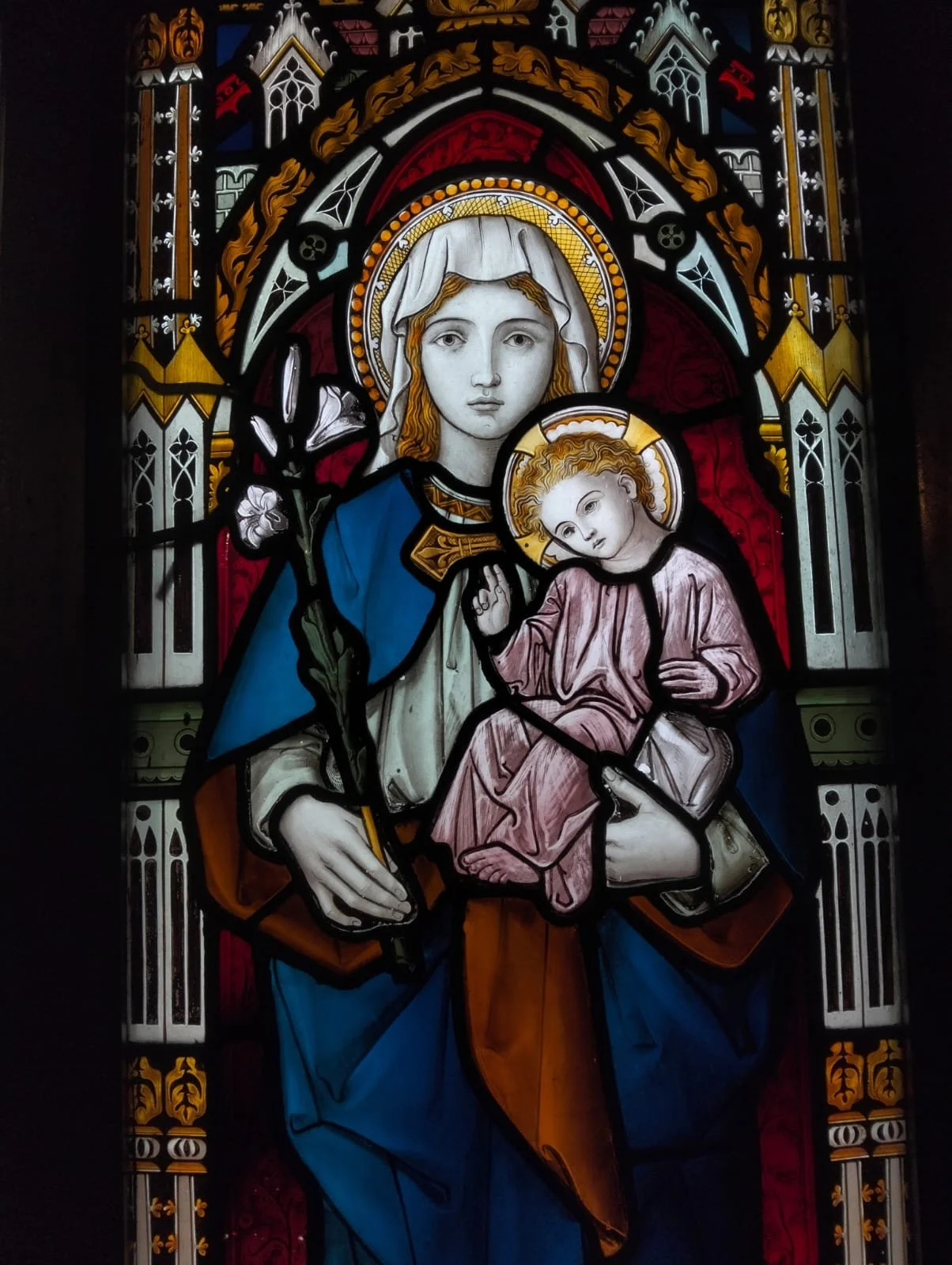
Mary and Child, East Window, St Mary’s Anglican Church, Christchurch
Circling back to our initial question, is there an inclusive way of invoking God as Trinity? And are there versions that are genuinely, soundly trinitarian, and also appropriate for devotional and liturgical use?
These questions are not new. Perhaps one of the most popular, inclusive language versions is:
In the name of God, the Creator, the Redeemer, and the Sanctifier, Amen. (5)
I heard a priest begin her sermon with this the other day. My heart, in truth, leapt for joy. But such a way of speaking also troubles me on another level. I think her willingness and courage to speak this way (and in a quite traditional setting) comes from a desire to name God in much bigger, more generous, and more liberating terms. It’s also a way of saying: pay attention! We've been living with this God language for a very long time. There is a danger of us becoming sleepy and “heard it all before”. Yet the thinker in me feels a bit wary: certainly, this language is authentically Christian, but as an invocation is it really trinitarian?
Instead of using names for God, this popular inclusive-language version evokes certain divine functions or actions and titles instead - namely, God as creating, redeeming, and sanctifying the world, God as the Creator, Redeemer, and Sanctifier. In this, there is a suggestion that not only one person within the Trinity takes a lead, or is more visible, in each of these functions/actions, but that such and such a “person” within the Trinity can be identified with one function/action in particular, therefore with this or that function-title.
The Father is the Creator or Creator aspect of God, the Son is the Redeemer or Redeemer aspect, and the Spirit is the Sanctifier/Sanctifier aspect. To my ears, and some others’ ears as well, this ends up sounding rather “Sabellian” or “modalistic”; technically, a form of heresy that speaks of the triune God in ‘modes of being’, affirming God’s oneness at the expense of God’s distinctness, person-ality, and identity as three-in-one.
To put it another way: creating isn’t an activity that only the Father does. The Son and the Spirit are intimately involved, too. Likewise, redeeming. It is not just the Son who is crucified and suffers (as some theologians settled on, even restricting this further to the humanity of Jesus alone, in some accounts). The Father and the Spirit also suffer. It is not just the crucified Son who hangs on the cross, walled off, somehow, from the impassive (and, in some theologies, sadistic) Father, and (in my imagination) absent Holy Spirit. Rather, as Luther, Kitamori, and Moltmann all emphasized, all “persons” of the Trinity are present and suffer with the Son on the cross (rather than being absent, walled off, and unconnected, or suffer as the Son on the cross). Thus, it is possible to speak of a “crucified God”.
All of God shares in our pain and godforsakenness. This is precisely what we most need to be healed of - our sense of being alone and abandoned in suffering, evil, and death. Without God’s full and unqualified solidarity with the world's godforsakeness, there can be no full reconciliation of humanity and the universe. But if God was completely present on the cross, and nowhere else, then can be no victory over death or subsequent resurrection, it seems.
Though I very much like, or want to support, the inclusive intention underlying invocations such as the Creator, the Redeemer, and the Sanctifier, I remain concerned that they are not fully trinitarian, and that they risk blending God into a vagueness.
So, what are the alternatives (to the alternative)? Are there any?
In the name of God, the Father and Mother of us all, the Creative Word, and the Life-giving Holy Spirit…
sort of works, at least for me. However, it is hardly ideal: more cumbersome and lacking poetic unity.
In “Invoking the Trinity: An Expansive Liturgy”, Hannah Bowman suggests and gathers other alternative invocations that are more theologically sound while remaining “expansive” in intent. These include Abba, Christ, and the Paraclete (but that seems to skew us towards the masculine, again, in my view), and Source, Word, and Spirit (which I quite like, but Bowman concedes, and I do agree, lacks “poetry and emotional intimacy”).
Here’s my own suggested formulation/invocation. Its theological foundation is Saint Augustine’s approach to understanding the Trinity through an analogy with mutual love - God as the Lover, the Beloved, and the ‘bond of love’ or shared love that unifies the two. (6). It also invokes John V. Taylor’s notion of the Holy Spirit as “the go-between God”, as “the elemental energy of communion itself, within which all separate existences maybe made present and personal to each other.” (7).
This ‘inclusive Augustinian’ approach has the advantage of being soundly trinitarian, appropriate for devotional use, inclusive in the sense of applying to both/all genders (without privileging the masculine in particular), and useful for explaining and affirming a notoriously tricky doctrine of our faith. It’s simple and so obvious in a way - written on every page of the Gospels, and in our human hearts.
It also may help wake us up again to who and how God truly is, if we are in need of such a tonic for our spirits.
So here it is, a longer version to begin with:
In the name of God, the Source of Love, the Beloved One, and the Love Between, Amen.
Or even more purely:
In the name of God, the Lover, the Beloved, and the Love Between, Amen.
Finally, there is the invocation that Carole Graham began her aforementioned sermon with, using the poetry of Anglican priest, Jim Cotter:
In the name of the Earth-maker, the Pain-bearer, and the Life-giver, Amen.
Such a formulation still tends towards the modal/Sabellian. However, its crispness and imagistic energy resists all theological vagueness and waffle, while being invoked in an otherwise catholic, orthodox context, and against the steady background of thousands of years of the traditional formula being faithfully intoned, leaves the listener little doubt as to its trinitarian pattern and depth of Christian truth.
Originally, Jim Cotter's prayer used the following words for its invocation: Eternal Spirit, Life-Giver, Pain-Bearer, Love-Maker. This phrasing was revised and amended by the Anglican Church in Aotearoa, New Zealand, and Polynesia, when it was included as an alternative Lord's Prayer in the ‘Night Prayer’ section of A New Zealand Prayer Book. (8).
Personally, I prefer Earth-maker as a alternative name for the Father to the more regular, Nicene Life-giver (notwithstanding that Life-giver is more often a title for the Holy Spirit). And there's something quite New Zealand about Earth-maker, given our nickname and reality as “the shakey isles”.
But, following Bosco Peters, I also regret the loss of God our Love-maker from our Prayer Book (8). Once upon a time, God as Love-Maker would have seemed quite racy and startling to me. But now I am beginning to receive and experience it as strikingly faithful, as getting to the heart of things.
UPDATE:
I’ve been trying out these alternative, inclusive-language invocations for about a week now in my daily prayers…
I do think there is liturgical merit, as one of my friends said, in mixing up the invocations - in having a range of sound trinitarian invocations, traditional and inclusive-language - that we can use. Having said that, I have found my current preference is for A New Zealand Prayer Book's version of the Jim Cotter version:
In the name of the Earth-maker, the Pain-bearer, and the Life-giver…
Generally, I prefer Life-giver to Love-maker as a description for the Holy Spirit, though both feel resonant and theologically sound to me, and Love-Maker feels so fresh and impactful, that it should definitely be an available part of the liturgist’s canon.
I think I prefer Life-giver on the whole as it (1) corresponds to my actual experience of the Spirit in prayer, and in Quaker worship and spirituality in which the Holy Spirit is emphasized, and (2) has deep theological roots and whakapapa.
Christianity is a manifested life, and it is this because it is the sphere in which the Spirit, the Life-giver, finds His freeest and most unhindered activity…The Spirit is life; that is His chief characteristic. (9)
This quote brings is back, again, to the issue of gender and the Trinity, especially the gender of the Holy Spirit. Is the Spirit feminine, as she largely is in the Old Testament (Ruach, Hokmah, Shekinah), or masculine, as he begins to appear more frequently as in the New Testament (Paraclete being a masculine noun) and in some subsequent Christian theology (probably because of the tighter association with Jesus). Or, perhaps similar to other persons of the Trinity, is the Spirit inclusive of and beyond gender too - as the English word Spirit and Pneuma (neuter in Greek) implies? Like the Trinity, perhaps, this is an endlessly circling discussion in which the best answer might be “all of the above”.
References:
(1) This verse has been subject to some scholarly discussion as to its authenticity as the words of Jesus and the early church. Reviewing this debate, and arguing for its authenticity, see: Jacob T. Hundu, “Examining the Evidence: The Case for and Against the Authenticity of Matthew 28:19”, in The American Journal of Biblical Theology Vol. 25(42). Oct. 20, 2024.
(2) The Cloud of Unknowing, translated by Clifton Walters (1961), p 60.
(3) Gerald Bullett, “Winter Solstice" (1943), in Bullett, Poems (1949).
(4) Sermon preached by Reverend Carole Graham on International Women’s Day, Sunday 8 March 2026, at Christ Church Cathedral. The sermon can be viewed at: https://www.youtube.com/live/iIdp-FIqrVk?si=YvGOgXTG_N7kv8Di“God as Trinity: Lover, Beloved, Love”
(5) In Aotearoa New Zealand, this can be found in A New Zealand Prayer Book, the official prayerbook of the Anglican Church in Aotearoa, New Zealand, and Polynesia (see, for example, p.185, in the ‘Night Prayer’ of the 2005 edition), as well as in use in other Anglican provinces and churches throughout the Anglican Communion.
(6) Saint Augustine, On the Trinity, can be accessed online here ; for other ‘Augustinian’ approaches to God as a Trinity of love, see sermons by Anne Edge Dale, “Lover, Loved, Love” ; and Joel Miller, “God as Trinity: Lover, Beloved, Love” .
(7) John V. Taylor, The Go-Between God (1972), p.18.
(8) See Bosco Peters, “God our Love-Maker”. Retrieved from: https://liturgy.co.nz/god-our-love-maker
(9) Charles Gore, “The Holy Spirit and Inspiration”, in Charles Gore (ed.) Lux Mundi (1890), p.317.