How do we interpret the “imprecatory psalms”?
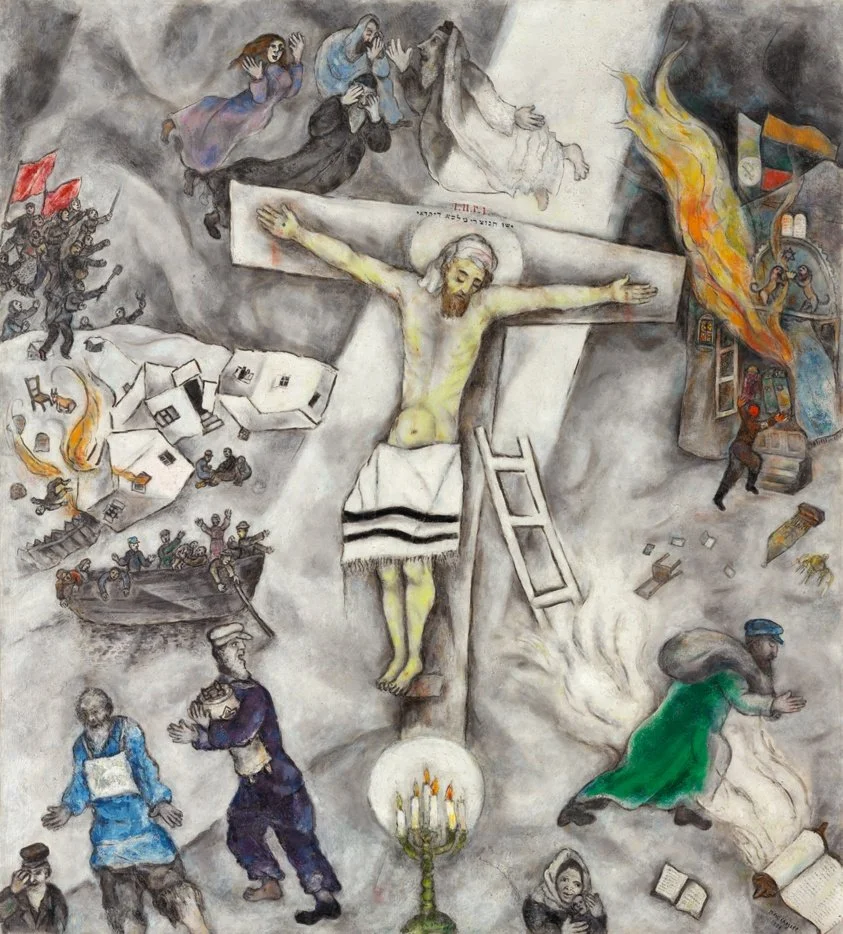
Marc Chagall, White Crucifixion (1938)
In the context of the US-Israeli war against Iran, a significant hermeneutical and theological issue has regained prominence: how do we interpret the “imprecatory [‘cursing’] psalms”? More generally, how do we interpret strong images of violence that are associated with God in parts of the Old Testament (and sometimes, even, in the New)?
Examples of this include:
O God, break the teeth in their mouths; tear out the fangs of the young lions, O Lord! (Psalm 58: 6).
Happy shall they be who take your little ones and dash them against the rock! (Psalm 137:9).
Pete Hegseth, the current U.S. “Secretary for War”, and many others (throughout history) want to interpret such texts literally, and put them to use against “our enemies”. Thus, he recently prayed:
Let every round find its mark against the enemies of righteousness and our great nation…
Give them wisdom in every decision, endurance for the trial ahead, unbreakable unity, and overwhelming violence of action against those who deserve no mercy.
In a recent article, the National Catholic Reporter observed:
Hegseth began [another one of his ‘official’, public prayers]… with the words: "Almighty God who trains our hands for war and our fingers for battle." This line is taken directly from Psalm 144 which begins, "Blessed be the Lord, my rock, who trains my hands for war, and my fingers for battle." When Hegseth asks God to “break the teeth of the ungodly,” he is repurposing both Psalm 3:7 and Psalm 58:6, both of which refer to God “breaking the teeth of the wicked.” And when he implores “Pour out your wrath upon those who plot vain things and blow them away like chaff before the wind,” he is combining language from as many as five Psalms (1, 2, 35, 69 and 79) while still managing to add the decidedly modern language of “blow [them] away.” There is more, but these examples will suffice. (1)
While this approach has appalled Christians across the spectrum, it is also an opportunity to understand our tradition more thoroughly, better, and to articulate, in simple, clear, theological terms, why we find such uses of the Bible so appalling.
Karen Park, theologian and historian, and author of the above National Catholic Reporter article, goes on to contrast Hegseth’s literalist, bellicose approach with a long-standing Catholic tradition, founded on such Fathers as Origen and Augustine:
The imprecatory Psalms are among the most difficult texts in the Bible, which is why they have, for millenia, been interpreted by Christians through a particular theological hermeneutic. From the first century onward, the Christian tradition has not treated them as straightforward calls for vengeance. In the words of Origen of Alexandria (circa 185-circa 253) in First Principles, “By the history of wars, and of the victors, and the vanquished, certain mysteries are indicated to those who are able to test these statements…”.
…In his Expositions on the Psalms, Augustine confronts the imprecatory Psalms and insists that they cannot be read as endorsements of hatred or cruelty toward other human beings for the simple reason that then they would not be from God.
“Trains our hands for battle and our fingers for war” refers, according to Augustine, to the conquering of our enemies by works of mercy and charity. And calls for God to break the enemy's teeth refer not to physical violence, but to the silencing of evil and destructive words. (2)
Such psalms, therefore, should be understood symbolically, as referring to the spiritual battle within our hearts, and against the ultimate criterion of God-as-love as revealed by Christ, rather than taken literally and put to use in war. For an explanation and affirmation of this approach, see this short YouTube clip by Bishop Robert Barron:
In therapy, I have worked with a number of people from both evangelical and Catholic backgrounds for whom the violence in parts of the Old Testament prevents them from believing and attending church, even though another part of them is desperately wanting to find a way. And for many of us who do believe and attend, such an association between God and violence introduces deep seeds of caution and doubt, often working to prevent more complete trust and surrender.
It even inspires a present day sort of Marcionism - a tendency, amongst individuals and some churches and liturgies, to stick to reading the New Testament only, and put aside the Old Testament with all those difficult passages.
Of course, Jesus is incomprehensible without the Old Testament - not least because he keeps on quoting it! He also becomes disturbingly anti-Jewish and disembodied in “Marcion” (Gnostic) versions.
Personally, I am sympathetic to the symbolic approach (as per Origen and Augustine). For a period, it fascinated me and gave me hope. I intend to do some more study later in the year, on the Old Testament, as it turns out. Perhaps then I might be in a better position to offer a more informed comment than I am about to attempt here! But…
The symbolic approach now strikes me as somewhat dishonest and equally hard to believe, and over-spiritualizing the complex - and often dark - reality of being human.
Is that what the authors of the Psalms actually intended - for phrases such as “breaking the teeth of our enemies” to really mean, in Pope Leo’s own magnificent words, a “disarmament of speech”? That is, no doubt, a beautiful, creative, and spiritual interpretation. But is it historically accurate, and does that question even matter?
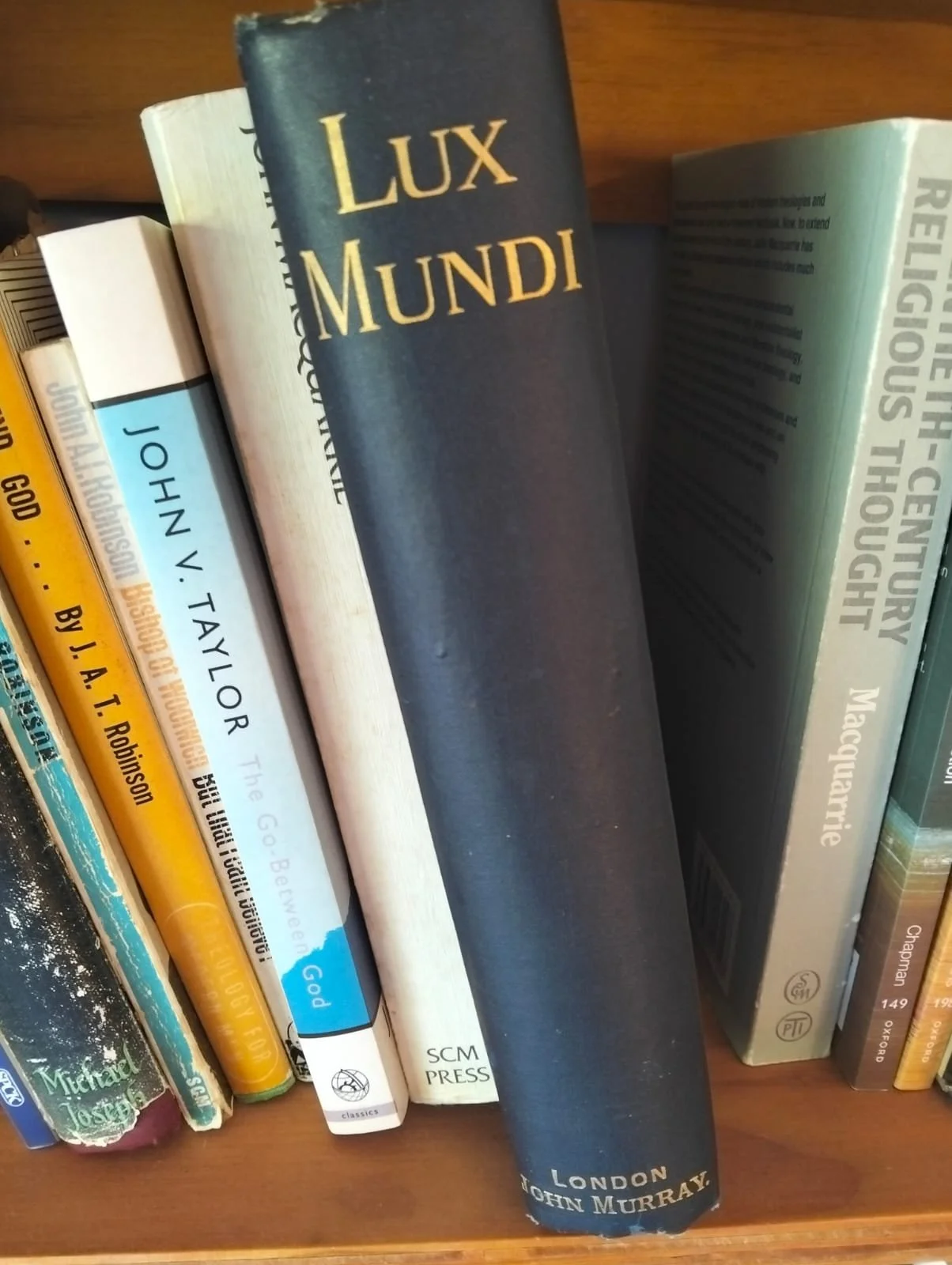
Just before the turn of the century, in 1889, a group of English, high-church Anglicans wrote a book of essays entitled Lux Mundi: A Series of Studies in the Religion of the Incarnation. While defending orthodox doctrines, not least the incarnation, and with ample reference to the early Church Fathers (Irenaeus, Athanasius, Saint Ambrose, Augustine, Origen, Saint Basil, Cyprian etc.) and later scholastic theologians (Aquinas, Anselm - though, regretfully, no references to Abelard in discussion of the Atonement!), the Lux Mundi group nevertheless attempted to open up Anglican Theology to the insights of modern knowledge - especially the theory of evolution and modern historical Biblical criticism. Their efforts were largely successful, producing the liberal Catholic stream within Anglo-Catholic and Anglican thought, and more generally helping to prevent Protestant fundamentalism, with its doctrines of creationism and biblical inerrancy, from taking a stronger hold on Anglicanism than might otherwise have been the case.
The best essay of the collection was Charles Gore’s “The Holy Spirit and Inspiration”, which, among other things, argued that it is the character of the Old Testament to be “imperfect” (gesturing towards a fulfilment that in itself, it does not and cannot offer), and that it is character of the Holy Spirit, who inspires the Holy Scriptures, to reveal God’s truth and character in a gradual manner.
Please excuse the length of the following quote, as well as its persistently sexist language (making the point, once again, regarding the slow, gradual revelation of truth):
The Old Testament, for example, presented a most unspiritual appearance. Its material sacrifices, its low standards of morals, its wordliness, were constantly being objected to by the Gnostic and Manichaean sects, who could not tolerate the Old Testament canon. ‘But you are ignoring,’ the Church replied, ‘the gradualness of the Spirit’s method.’ He lifts man by little and little. He puts up with him as he is, if only He can at last bring him back to God.
It is of the essence of the New Testament, as the religion of the Incarnation, to be final and catholic: on the other hand, it is of the essence of the Old Testament to be imperfect because it represents a gradual process of education by which man was lifted out of sin and ignorance….for men do not easily abandon what long custom has consecrated. Thus the first law, while it abolished their idols, tolerated their sacrifices; the second, while it abolished their sacrifices, allowed them to be circumcised: then when once they had accepted the removal of what was taken from them, they went further and gave up what had been conceded to them…being betrayed as it were by gradual changes into acceptance of the Gospel. (3)
While Gore is affirming a progressive, gradualist view of Christian revelation - with regard less to God as God’s “condescension” to humanity’s historical and social embededness, and epistemological and spiritual limitations to receiving the Divine presence and truth - and which he claims was widespread amongst the early church fathers, he was far from being a naive, liberal optimist when it came to church, history, and society. (4) And of all the authors in Lux Mundi, he is the most steeped in a knowledge of the Bible and patristics.
How does this apply to Hegseth, Augustinian symbolism, and the imprecatory psalms?
When I was growing up in Roman Catholic parishes and schools, we were taught, implicitly and otherwise, a way of reading the Old Testament and reconciling it with the Gospel of Christ. It was not the symbolic approach of Origen and Augustine, but the simple progressive approach that Charles Gore affirmed (with greater depth and eloquence) too. Simply, we don’t have to defend or spiritualize every passage in the Old Testament. It is its nature to be imperfect and provisional, and to receive its fulfilment and clarity in Christ.
This eventually takes us into discussions on the historical Jesus, about which Gore and other members of the Lux Mundi group had open-minded yet also critical comments to make. But that topic is most certainly for another day!
I found myself reacting against over-spiritualizing approaches to Biblical texts in a recent Good Friday service. We were reflecting on the last words of Jesus. The reading assigned to me was from John (19:28-30).
Later, knowing that everything had now been finished, and so that Scripture would be fulfilled, Jesus said, “I am thirsty.” A jar of wine vinegar was there, so they soaked a sponge in it, put the sponge on a stalk of the hyssop plant, and lifted it to Jesus’ lips. When he had received the drink, Jesus said, “It is finished.” With that, he bowed his head and gave up his spirit.
Afterwards, a reflection was read on what Jesus might “thirst” for in broader, symbolic terms - our well-being, salvation, our redemption in God. At the time, I thought: please, don't interpret this symbolically! And don't talk of him quoting the Psalms (69:21) either! Today, on this day of all days, all symbolic interpretations seem a defense against the horror of the dying Human One (“Son of Man”), “the crucified God”. He thirsts because he is dehydrated and dying, like so many others have and will do.
In citing the symbolic approach, I suppose Karen Park is drawing our attention to the Augustinianism underpinning Pope Leo’s formation and present interventions (Leo was previously prior general of the Order of Saint Augustine). However, the progressive approach, to me, makes more sense of Leo quoting both Jesus and Isaiah in the present, horrifying context of war and death:
Blessed are the peacemakers! (Matthew 5:9).
Even though you make many prayers, I will not listen: your hands are full of blood. (Isaiah 1:15).
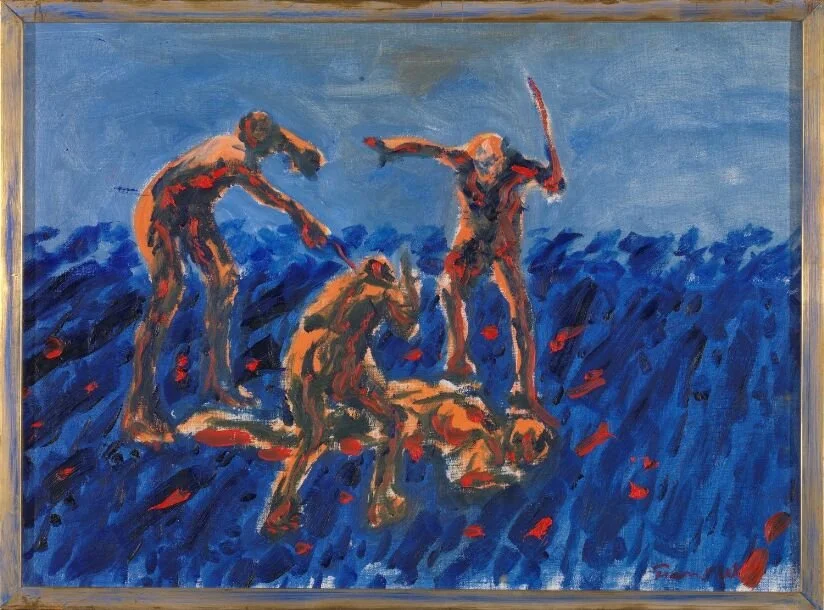
Franz Widerberg, Hevnerne
The Catholic tradition speaks of four senses of scripture (5):
The literal or historical sense - which is primary, and sets the basic possibilities for exegesis.
The allegorical or metaphorical sense - what the text might mean symbolically.
The moral sense - what the text might mean for how we live our lives.
The anagogical or contemplative sense - discerning a text’s deeper, spiritual significance.
I find this approach helpful in that it supports us to read and interpret scripture in a way that both allows for a multiplicity of meanings, yet organises our reading in a unified, spiritually purposeful way.
Approaching the imprecatory psalms from this perspective, one might argue that they are aggressive and war-like at the literal/historical level, but, under the guidance of the Spirit, in symbolic, moral, and spiritual senses, they are to be interpreted in an entirely different way (consistent with God-as-love). I don’t find such a reading very convincing, however.
If the literal/historical sets the basic possibilities for subsequent interpretation, the imprecatory psalms seem to either set the possibility for grave violence to be encouraged and glorified, or they record - and refuse to cover-over and forget - how demonic and misguided human beings can be.
Hear what the Spirit is saying to the Church.
Does the Holy Spirit inspire us to produce heavenly texts, smoothed out of apparent contradictions and inner-conflicts? Or does she enbolden the prophets in their work, often rebuking those within their own tradition?
You have heard that it was said, ‘You shall love your neighbour and hate your enemy.’ But I say to you, Love your enemies and pray for those who persecute you… (Jesus, in the Gospel of Matthew, 5: 43-44).
Woe to those who manipulate religion and the very name of God for their own military, economic and political gain, dragging that which is sacred into darkness and filth. (Pope Leo, speaking during his recent visit to Cameroon).
The world is being ravaged by a handful of tyrants, yet it is held together by a multitude of supportive brothers and sisters. (Pope Leo, as above).
References
(1) Karen E. Park, “St. Augustine is key to the difference between Pete Hegseth and Pope Leo”, National Catholic Reporter, April 8, 2026
(2) As above.
(3) Charles Gore, “The Holy Spirit and Inspiration”, in Charles Gore (ed.), Lux Mundi: A Series of Studies in the Religion of the Incarnation (1890 edition), pp.328-329.
(4) See Arthur Michael Ramsey, From Gore to Temple: the Development of Anglican Theology between Lux Mundi and the second World War 1889-1939 (1960).
(5) Catechism of the Catholic Church, 115-119.