Addendum: the three courages
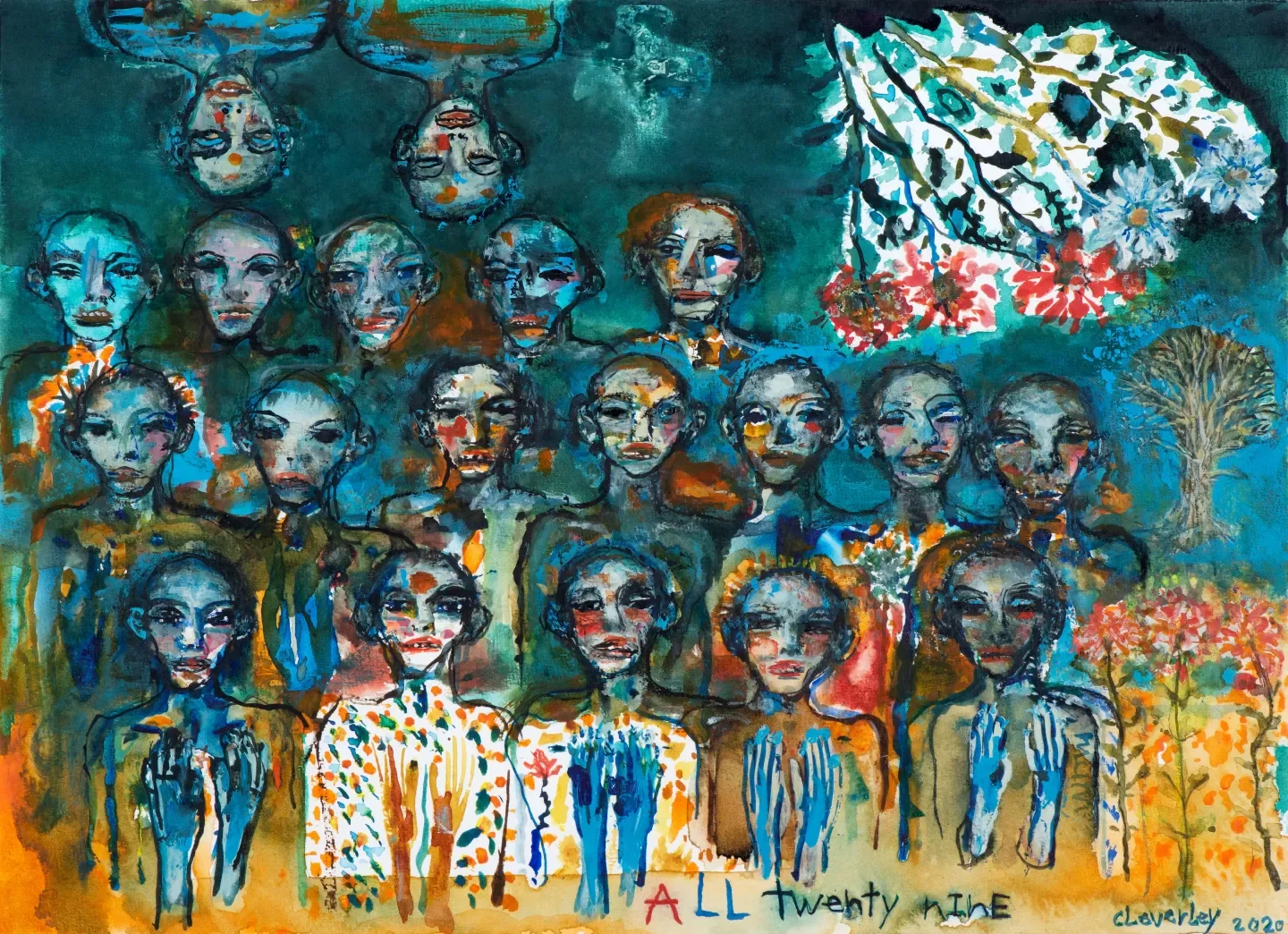
Peter Cleverly, All twenty-nine
In the last post I discussed Paul Tillich’s The Courage to Be in relation to the crisis of ‘Burnout Christianity’. Tillich’s small book sets out to “correlate” core aspects of Christian theology with the modern crisis of anxiety, meaninglessness, and the fear of non-being. Thus, he speaks of “three courages”: the courage to be a part, the courage to be oneself, and the courage to accept acceptance.
Tillich has gone in and out of fashion as a theologian. Currently, he is less in fashion, I think. His writing can be very dense. You have to go slowly! The great strength of Tillich, however, is that he takes the problems of modern life seriously, and, within them, under them, discerns serious, genuine ‘religious’ questions.
The Courage to Be was written in 1952, and yet I still find its ideas very relevant and prescient in terms of my Christian journey, contemplative practice, my own wrestling with anxiety, etc., and in my practice as a psychotherapist supporting others in their wrestling with faith, life, and suffering.
At the end of the last post, after discussing some of Tillich’s ideas, I spoke of attending an Anglo-Catholic church service during Holy Week:
My head is dripping water, and now I smell the church. Ah, it is a church - made of wood and stone and vaulted space. It is a church, not a modern lounge or theatre.
The service is solemn and moving. It has melodies that open my heart…
And there are things I dislike and tolerate: the sheer distance of the clergy from the parishioners. The constant ‘Almighty Father’ for God.
I’ve attended this church again on subsequent occasions. With its beauty, rich symbolism, sacramental spirit, ritual participation, ceremonial formality, and traditional preaching, as well as my sense of being new and a rather estranged from the large, established congregation, it is an attractive challenge in terms of Tillich’s ‘three courages’.
The courage to be a part:
Can I allow myself to go along with the programmed liturgy, to listen to the preaching and traditional language, without getting too caught in “the desert of criticism” (intellectual commentary, critical pushback, distancing myself, emotionally and somatically, from the ritual and congregation etc.)?
The courage to be oneself:
Can I participate in the power of being with others while simultaneously being myself?
Can I accept my goodness, uniqueness, and gifts as a person, and live in that freedom that takes away absolute allegiance to “the law”, including submission to a sense of liturgical tightness and emotional reserve?
The courage to accept acceptance (Tillich’s modern version of ‘justification by faith’):
Can I let go and centre down into the presence and mystery of being, and accept that I am accepted just as I am - especially in new, unfamiliar settings and when feeling alone or ‘estranged’?
Can I accept others are accepted just as they are? Can I accept others just as they are, too?
Can I let everything be as it is - within and all around? (1)
Can I let everyone be as they are?
These questions keep the Gospel freshly before me in relation to the quest and responsibility of being human.
In fact, I would go so far as to say: if any Christian ministry - verbal preaching, liturgical worship, contemplative practice, etc. - is not addressing at least one of these “courages”, it is perhaps lacking something important and prophetic in terms of its contemporary relevance and alignment with the Gospel.
This is just a brief introduction to some of the contributions The Courage to Be can make as we reflect on situations in our everyday life, including our wrestling with church and faith. For a more thorough, gutsy, and user-friendly introduction and discussion of Paul Tillich and his important book, The Courage to Be, see
Paul Tillich: The Courage to Be - Anxiety, Meaninglessness, and Existential Courage
Reference
(1) This phrase is also a very useful way of settling into meditation, as suggested and discussed by Adyashanti in True Meditation (2019).