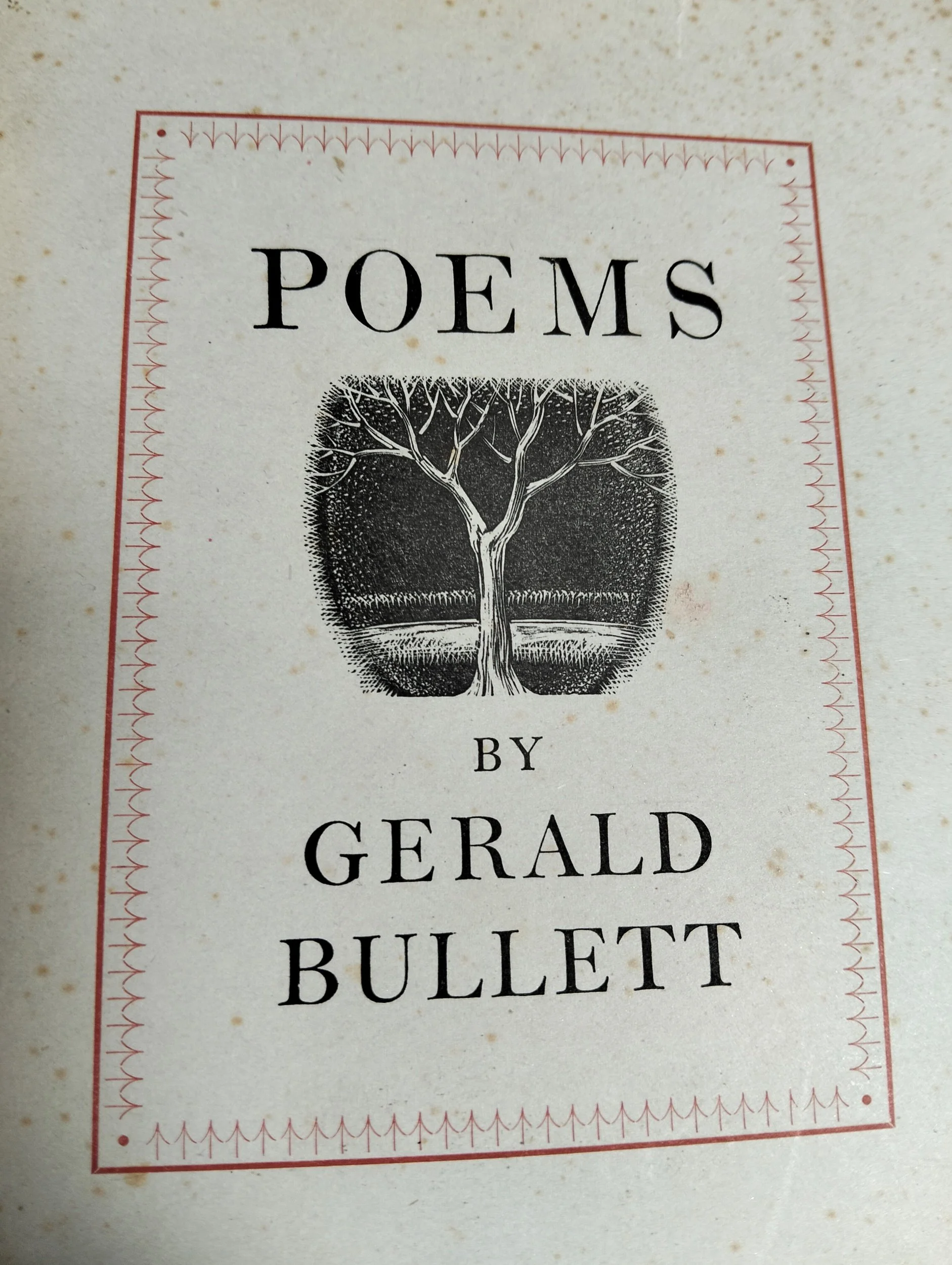
In 1950, Gerald Bullet, a wonderful mid-century English writer and poet, wrote a book of essays called The English Mystics. I have been reading his essay on George Fox, in which he quotes Richard Hooker, perhaps the most famous, foundational, Anglican theologian:
Dangerous it were for the feeble brain of man to wade far into the doings of the Most High; whom although to know be life, and joy to make mention of his name, yet our soundest knowledge is to know that we know him not as indeed he is, neither can know him, and our safest eloquence concerning him is our silence, when we confess that his glory is inexplicable, his greatness above our capacity and reach. He is above, and we upon earth; therefore it behoveth our words to be wary and few. (1)
Once again, Hooker is arguing for a balance, a moderation; specifically, here, a balance of word and silence (presumably in theology and worship, both).
Although Hooker goes on to affirm union with God as the ultimate goal, these affirmations were never interpreted and developed, as far as I know, and have experienced in Anglican churches, in the sense of a true Anglican mysticism.
And yet, how can the Presence, the silence, not be here?
In Anglicanism, it appears to me, silence is a recognition of the limits of our mind. Or an aesthetic complement to word and music: a void that allows the notes of the hymn (or scripture reading ) to reverberate and sound more deeply.
Or just a space to think further on the sermon!
And it is indeed these things. But, spiritually, it is much more.
For mystics, silence and stillness is the gate through which we pass from the negative to the positive - a bridge beyond our limited words and perceptions, and an entry into the kingdom. The Presence. Pleroma.
The Quaker way, and sometimes this is lost on modern liberal Friends, shows that silence is a process, a method; both personal and interpersonal, a way of inward prayer (towards union), and a way, surprisingly, for ordering worship and church governance. A discipline, plodding and imperfect, that needs to be cultivated and learned, sometimes, or often, in a group. As well a perfection of sorts, a end itself, a continuous going-on-being.
English people, English Christians, Christians and people with a Western, English whakapapa, Anglicans even, don’t need to ‘go East’ or ‘swim the Tiber’. There is an English form of mysticism. There are many English mystics (Rolle, Julian, the author of the Cloud) of course, and mystical, English poets, too (Milton, Herbert, Wordsworth, Bullett, Eliot).
And there are some forms of English mysticism that are “reformed”, somewhat - that have been shorn, somewhat, of authoritarian religious elements. And that have been shorn, or are being shorn, of patriarchal elements too. You don’t have to become a Buddhist or a Cistercian (if you don’t want to).
Even if Anglican forms of silence don’t go “all the way” - and who am I to judge? - silence is still silence. Intellectual and aesthetic silence provides an opening into richer ground. God is faster than we think and bigger than these little distinctions I am making.
Nothing, nameless, nowhere, everywhere:
When you came to your cradle I was there.
Creaturely kind in lion and lamb,
In star shining, in bud breaking, I am.
These lines are from the last stanza of Bullet’s extraordinary “Winter Solstice”:
I am fear and faith, the fall and contrition.
The aching hope and the wry fruition,
The bread of communion, the wine of bliss,
The living water of quietness.
Nature has a silence that is a fullness, too. Abundant life. You don’t have to leave your home, your local garden or church. Without ‘winter’, we can’t enter the plenitudes. This pattern is inscribed in Christ, is Christ.
The corn ripening, the linnet calling,
The first feathers of dusk falling,
The comrade, the lover, the casual friend,
I am that you shall find at the day’s end. (2)
In practice, all Anglicans are mystics, aren’t they? ‘Anonymously’, as Karl Rahner might have said, or otherwise.
I would be very happy to see more appreciation for silence within Anglicanism, on Anglican terms, such as Hooker outlines. A silence to discipline human excess. Not knowing too much - or speaking too much! To contain a vigorous Anglican tendency towards clutter, in certain settings.
To contain a tendency towards knowing too much and speaking too much, and worshipping the word (or the rules or the Bible) above the Presence, above the Spirit, in other Anglican settings.
I also think it would help make Anglicanism more approachable to many newcomers; to make its many rules, words, and rites less overwhelming and opaque.
A silence to unlock Anglicanism’s treasures, to put it more positively. Its poetry of word and elements.
Addendum: Rowan Williams on silence and liturgy
Good liturgy is about silence. I don’t mean that good liturgy is all Quaker meeting, but that there’s something about liturgy that ought to be pressing us in that direction. In quite a lot of the church’s history, both Catholic and Protestant traditions have variously got this wrong. There’s been an urge to fill up the void, an anxiety about silence—whether it’s the urge to improve the occasion and go on teaching, making sure that people are getting the right ideas, or the urge to keep things happening with lots of ceremonial. Both often seem rather to miss the point; busy and cluttered talk, like busy and cluttered activity, just tells people that we’re busy and that we’re really rather anxious that they shouldn’t get things wrong. Making space, acting, moving, speaking in a way that makes space around it: that’s what liturgy needs to be. (3)
References:
(1) Richard Hooker, Of the Laws of Ecclesiastical Polity (1594-1597), quoted in Bullet, The English Mystics (1950), p.90.
(2) Gerald Bullett, “Winter Solstice" (1943), in Bullett, Poems (1949).
(3) Rowan Williams, “Silence in the face of mystery”, The Christian Century (2018).