Since feeling is first
This post might might be an evolving one, something I keep coming back and adding to, like a hundred day pot of soup.
Its central idea - a very simple one - has been slowly dawning on me as I practice ‘waiting on the spirit’, and as I keep reading and studying the Christian tradition (with an emphasis on Quaker spirituality).
Here’s the guts of it:
Different contemplative traditions use different “techniques” to help guide the seeker into a steady sense of being in the Divine Presence.
Some use a focus on the breath. Some use words like a small verbal prayer, mantra, or “sacred word” (as practiced, somewhat differently, in the Jesus Prayer, Christian Meditation, and Centering Prayer traditions, for example).
In this post, I want to focus on feeling as a guide in meditation/contemplative prayer.
Not feeling in the sense of feelings - as in emotions like sadness, anger, fear, shame.
But feeling as sensual contact with our inner world.
Feeling within - to begin with.
Feeling how we are - and accepting this.
And then tuning in to a particular felt sense that emerges out of the background - waiting for it to arrive, staying in touch with it, allowing it to build and deepen, following it as it shifts and transforms us - as a way of grounding and guiding our practice and exploration.
Something like this:
1. Sit down and get comfortable. Bring your attention to your feeling sense. Pay attention within.
2. Feel how you presently are - warts and all. Feel and accept whatever is there. Let everything be as it is. Allow the felt sense of yourself, and/or specific inner felt senses, to gradually emerge, deepen, and shift.
3. Tune in to a felt sense of peace (softness, stillness, beingness, relaxation) within. Where do you feel peace (or any of these qualities) right now within your body? It doesn’t matter if it’s just in one thumb or an ear. It doesn’t matter, too, if you feel it in a broader sense - sort of everywhere and nowhere - or if you feel it within as a response to another sensory figure (such as the felt sense of your breathing, or the pleasantness that spontaneously arises within when you look at some clouds, or hearing some word being recited etc). Stay with feeling-awareness. Wait for this “peace feeling”, this “warm spot” (however small at first) to emerge, to be felt, to deepen, to grow and become more steady. Stay in touch with this as you feel and encounter other elements within (or without).
(This “peace feeling”, this pleasant stillness and growing fullness-feeling, is part of the great background that comes forward in silent waiting. Notice that silence-stillness-peace has no beginning, middle, or end. It is a continuous, going-on-being. It is unbroken, whole, “undifferentiated”. As it grows, it gathers you up into a oneness that actually feels very good, delightful, refreshing, healing, holy, blissful. It becomes the foundation for all sorts of other inner ‘openings’ and safe ground and containment for when the spiritual journey becomes difficult, fearful, and challenging. It can be, in itself, a potent focus for spiritual inquiry and faith: what is this stillness-fullness feeling? Is it just physiological relaxation, or…? It can be experienced and explored in a seeming infinite, variety of ways. Sometimes it can feel like I am becoming butter. Or that a golden oil or nectar is being poured and infused through me. Mostly, I am speaking as if it is separate to me, to us - as that it is an ‘it’. But is it? What is this? Who are you? What Am I? Nothing, nameless, nowhere, everywhere. When you came in your cradle I was there...I am).
4. There is no strict linear sequence to any of this. Perhaps 3 comes before 2, or 2 before 1, in any given sitting. Who knows. Don’t try to make things happen in any particular order.
5. As we go on with this practice, it tends to become simpler and simpler. 1, 2, and 3 often happen simultaneously - as we turn within and simply feel. The Presence - or, rather, our awareness of the Presence - becomes more constant and everpresent, at hand in any moment in the day. And then, almost beyond awareness: The Presence becomes unconsciously us. Suffusing our lives, whether we remember it or not.
This is not the whole of of contemplation, of silent waiting and worship, but it is a very solid, enlivening start. God is life. God, as Holy Spirit, is the Lifegiver.
Here’s another image and description - a more sensual way of explaining what I mean:
You go swimming or bathing at a beach. The water’s a bit cold but tolerable. Enlivening, even. The seafloor feels sandy in places, rocky in other places. Suddenly you come across “a warm spot” - an inexplicable patch of warmer water. You're not sure why it’s there, or it’s dimensions, it’s shape. But it feels so lovely to just be in it. Ah, you just be and relax.
Finally, here's one “technique” I find helpful (there are so many) to support the shift from discursive thinking (often our automatic default) and into feeling. It works on the principle that our eyes are directly related to our mind:
“Mind release”: Relax your eyes. Soften your gaze. Feel the release of energy within - your body come alive. If your eyes are open, simply relax your face, soften your gaze, and feel within and all around. If your eyes are closed, soften your gaze. To begin with, you can gently focus on the threads and spots of light in the darkness in front of your closed eyelids, or any blotches of colour you see in your inner visual field. Gently focusing here shifts your eyes out of “thinking”. Feel your body come alive within, and feel the pleasant stillness and peace begin to glow and grow as you shift away from thinking-about to feeling-within. Or wait for this to emerge as you keep softening your gaze and gently focusing on the threads of light behind your eyelids.

That’s all I want to write about for now. I do have some questions for exploration later:
- Does ‘feeling-based spiritual practice’ only suit “feeling types” (of people)?
- What factors have lead/lead to a dulling of inner feeling - spiritual desensitization - in Western culture and Christianity? Does a lack of inner feeling in Christian spirituality go hand in hand with a diminishment of feeling in life more generally?
- Is this a distinctive Quaker approach - or early Quaker approach - to inner prayer?
- What other Christian groups and individuals emphasize feeling? I think of John Wesley’s heart “strangely warmed” and the emotional warmth of some Methodists and Methodist communities I have known. I think of Freidrich Schleiermacher who argued that religion is more a spiritual experience than a way of thinking or a system of rules, and how our relationship to God can be thought of as a ‘feeling of absolute dependence’. As one commentator notes, “‘Feeling’ isn’t quite the right term, though – for Schleiermacher, it’s more to do with perception, and how individual things relate to infinity. Schleiermacher suggests that everything that exists is a small part of infinity – he describes all finite things as being “cut out of the infinite.”.
For the rest of the post I want to gather quotes from other spiritual writers on this theme. I intend to keep adding to this “reader” as I come across more material.
From Isaac Penington (1616–1679), early Quaker mystic and writer (1):
“The Lord opened my spirit, the Lord gave me a certain and sensible feeling of the pure seed, which has been with me from the beginning; the Lord caused his holy power to fall upon me, and gave me such an inward demonstration and feeling of the seed of life, that I cried out in my spirit: “This is he, this is he; there is not another, there was never another. He was always near me, though I knew him not.” I gave up to be instructed, exercised, and led by him, in the waiting for the feeling of his holy seed....” (1)
“Give over thine own willing, give over thine own running, give over thine own desiring to know or be anything, and sink down into the seed which God sows in thy heart and let that be in thee, and grow in thee, and breathe in thee, and act in thee, and thou shalt find by sweet experience that the Lord knows that and loves that and owns that, and will lead it to the inheritance of life, which is his portion.” (2)
“…dost thou feel the life and power flowing in thee from the free fountain? Is the load really taken from thy back?” (3)
“There is a river, a sweet, still flowing river, the streams whereof will gladden the heart. And learn but in quietness and stillness to retire to God, and wait upon the Spirit, in whom thou shall feel peace and joy, in the midst of thy troubles from the cruel and vexatious spirit of the world.” (4)
“There is a pure principle of life in the heart, from whence all good springs…Mind therefore [God’s] leadings in thy heart and wait to be acquainted with its voice there.” (5)
“Wait to feel the relieving measure of life, and heed not distressing thoughts. When they arise ever so strongly in thee…fear them not, but be still awhile, not believing in the power which thou feels they have over thee, and it will fall on a sudden.” (6)
“God, who caused the light to shine out of the darkness, out of sin, out of the pollutions of the spirit, into the pure, holy fellowship of living…Here is unspeakable comfort and satisfaction given by him to the soul, which all the reasonings of men, with all the devices of Satan cannot damp.” (7)
“Wait to know the springings of life…sink very low and become very little; yea know no power to believe, act, or suffer anything for God but as it is given thee by the springing grace, virtue, and life of Jesus. For grace is a spiritual, inward thing, an holy seed and is sown by God and springs up in the heart. People have a notion of grace but know not the thing. Do not matter the notion, but feel the thing, and know thy heart more and more ploughed up by the Lord, that his seeds of grace may grow up in thee more and more, and thou mayst daily feel thy heart as a garden, more and more enclosed, watered, dressed, and walked in by him.” (8)
From George Fox (1624-1691), Quaker founder:
“Be faithful to the Lord God, attending to the seed, feeling it and being aware of it in yourselves.” (9)
“And feel the seed of God rise powerfully above whatever makes you suffer, and it will remain there when all the suffering is gone because because you will experience life as stronger than death, and light as stronger than darkness.” (10)
“Stay in the power of the Lord...That's where you’ll find a pure wisdom...Feel it in the heart, which is more than you ever find in the head or hear spoken....‘For faith comes from the heart, and the confession that leads to salvation comes from the lips’ (Romans 10: 10). First of all it is in the heart, before it comes out of the mouth, and that is beyond all that brain-bashing, heady stuff that people have mostly got into when they study the words of the saints [who wrote the Bible].” (11)
“Stay with the experience of the life [within you], and this will free you from a dependence on words.” (12)
From Scott Martin, ‘The Power,’ Quaking, and the Rediscovery of Primitive Quakerism (2001):
“‘The Power of the Lord,’ or just simply, ‘The Power,’ was a very important concept to the early Quakers, but it is virtually unknown among Friends today. In The Power of the Lord Is Over All: The Pastoral Letters of George Fox, T. Canby Jones notes that Quakers frequently say that Fox’s central teaching was there is ‘that of God in every one.’ Surprisingly, this phrase appears only 108 times in his writings. Variations of the "Power of the Lord’, appear, 388 times, and it is the single most often used phrase in his Journal.
‘The Power of the Lord’ had multiple meanings for Fox and other early Friends, but the most common use of the phrase was to refer to a sensible, divine power or energy. Friends would experience this power surrounding them or flowing through their bodies under a variety of conditions, but most often at the point of convincement, when facing a trial, or during meeting for worship. An experience of the power was often associated with some kind of involuntary physical or mental phenomenon. When seized by the power, some Friends quaked, vocalized, or fell unconscious to the floor, while other Friends saw brilliant light, had visions, experienced healing, or felt a force emanating from them that was capable of subduing an angry and hostile mob.
...While Asian religions conceptualize energy as an impersonal life force coming from within, Christianity tends to use the image of the indwelling of a personal Holy Spirit from above. Both, I think, are speaking about much the same experience.
I believe the energetic experiences of early Friends greatly influenced how they conceptualized their faith. Before Quaker notions such as ‘the power of the Lord,’ ‘inner light,’ or ‘the seed’ were abstract theological concepts, they were, I believe, actual bodily experiences. As John Mann and Lar Short point out in The Body of Light, ‘the physical body is the mediator of all our experiences,’ and this is especially true of our profound religious experiences. The body is truly the temple of the Holy Spirit.
...The writings of Isaac Penington contain many clues to his experiences with energy. Penington’s advice to sink down daily to the seed planted in the heart (a 17th-century term for ‘center’) is identical to instructions that might be given by a qigong teacher today. The Chinese concept of the dan tien is indistinguishable from Penington’s idea of the seed when seen not as an abstract theological statement, but as an actual location in the body. In fact, I thought of Penington immediately when I read the advice of Deng Ming-Dao, a modern-day Taoist: sit still and ‘fertilize the seed within; let it sprout into a flower of pure light’ (365 Tao Daily Meditations). Furthermore, Teresina Havens has pointed out in her pamphlet, Mind What Stirs in Your Heart, that Penington’s references to ‘true breathings’ and the ‘breathing life of the seed’ suggest that he understood the connection between breathing and prayer, and, I might add, the cultivation of energy in his own body. I think Havens is absolutely correct when she implies that Penington’s frequent use of phrases such as the "rising of the power" and “purely springing life” suggests that these were actual, bodily experiences. He says as much when he writes, ‘In your meetings . . . be every one of you very careful and diligent in watching to his power, that ye may have the sensible living feeling of it.’"
....Why is it that the early Quakers had such an intense experience of the power while we do not today? My guess is that the widespread practice of daily retirement in that time may have been a factor. Both Fox and Penington, for example, were known for their ability to sit for many hours at a time. Tranquil sitting is a powerful method of energy cultivation, and although from the outside it may look like the body is inactive, much is happening inside on an energetic level. In abandoning the practice of daily sitting, which might legitimately be called the ‘Quaker yoga,’ modern Friends may be cutting ourselves off from a deeper, more profound experience of worship. It is only logical that Friends who sit only on First Day simply cannot have as deep an energetic experience as those who have done this every day for many years.
....I think the time is right for a rediscovery of the power and daily sitting. Many Friends, like me, are experiencing what Harvey Cox calls an ‘ecstasy deficit.’ We read the accounts of the early days of Quakerism with a certain amount of envy, sensing that there is a greater depth to our faith than we are experiencing today. Worship often feels flat, and we wonder if we are doing something wrong. We feel frustrated that our practice does not seem to transform us. Those traditional Quaker qualities of peacefulness, acceptance, and love seem to elude us. We are tired of reading books about other people’s experiences. We want to get out of our heads and into our bodies. We seek a deeper healing.
Isaac Penington’s advice to the seekers of the 17th century applies equally to the seekers among us today: Oh, sit, sit daily and sink down to the seed and ‘wait for the risings of the power . . . that thou mayst feel inward healing.’

E. E. Cummings, American poet (1894 –1962):
since feeling is first
since feeling is first
who pays any attention
to the syntax of things
will never wholly kiss you;
wholly to be a fool
while Spring is in the world
my blood approves,
and kisses are a better fate
than wisdom
lady i swear by all flowers. Don’t cry
—the best gesture of my brain is less than
your eyelids’ flutter which says
we are for each other: then
laugh, leaning back in my arms
for life’s not a paragraph
And death i think is no parenthesis
Tarthang Tulku (born 1934), Tibetan Buddhist teacher and lama:
“Although meditation is actually very simple, it is easy to get confused by the many different descriptions of meditative practices. Forget them all and just sit quietly. Be very still and relaxed, and do not try to do anything. Let everything - thoughts, feelings, and concepts - go through your mind unheeded. Do not grasp at thoughts or ideas as they come and go or try to manipulate them. When you feel you have to do something in your meditation, you will only make it harder. Let meditation do itself.
After we learn to let thoughts slip by, the thoughts will slow down and nearly disappear. Then, behind the flow of thoughts, you will sense a feeling which is the foundation of meditation. When you contact this quiet place behind your inner dialogues, let your awareness of it grow stronger. You can then simply rest in the silence.” (13)
Thomas Keating (1923-2018), Cistercian monk and founder of Centering Prayer:
“Spiritual attentiveness: The general loving attention to the presence of God in pure faith, characterized…by an undifferentiated sense of unity…”. (14)
J. Krishnamurti:
“Power is derived from asceticism, from action, from position, from virtue, from domination and so on. All such forms of power are evil. It corrupts and perverts. The use of money, talent, cleverness to gain power or deriving power from any use of these is evil.
But there is a power which is in no way related to that power which is evil. This power is not to be bought through sacrifice, virtue, good works and beliefs, nor is it to be bought through worship, prayers and self-denying or self-destructive meditations. All effort to become or to be must wholly, naturally, cease. Only then that power which is not evil, can be.” (15)
References:
Let everything be as it is - a quote from Adyashanti (2019), True Meditation.
Nothing, nameless… - a quote from Gerald Bullett, “Winter Solstice" (1943), in Bullett, Poems (1949).
(1) Isaac Penington quoted in Bernard Canter (ed.), The Quaker Fireside Book (1952), pp.18-19.
(2) Penington, above, p.21.
(3) Penington quoted in Ruth Tod, Exploring Isaac Penington (2023), p.21.
(4) Penington, as above, p.27
(5) Penington, as above, p.29.
(6) Penington, as above, p.31.
(7) Penington, as above, p.31.
(8) Penington, as above, p.45.
(9) George Fox quoted in Rex Ambler (ed), Truth of the Heart (2001), pp. 43.
(10) Fox, above, pp. 43, 45.
(11) Fox, above, p.45.
(12) Fox, above, p. 27.
(13) Tarthang Tulku, Openness Mind (1978), pp.31-32.
(14) Thomas Keating, Open Heart, Open Mind, (4th edition, 2006), p.190.
(15) From Krishnamurti’s notebook; https://kfoundation.org/krishnamurtis-notebook-krishnamurtis-process/.
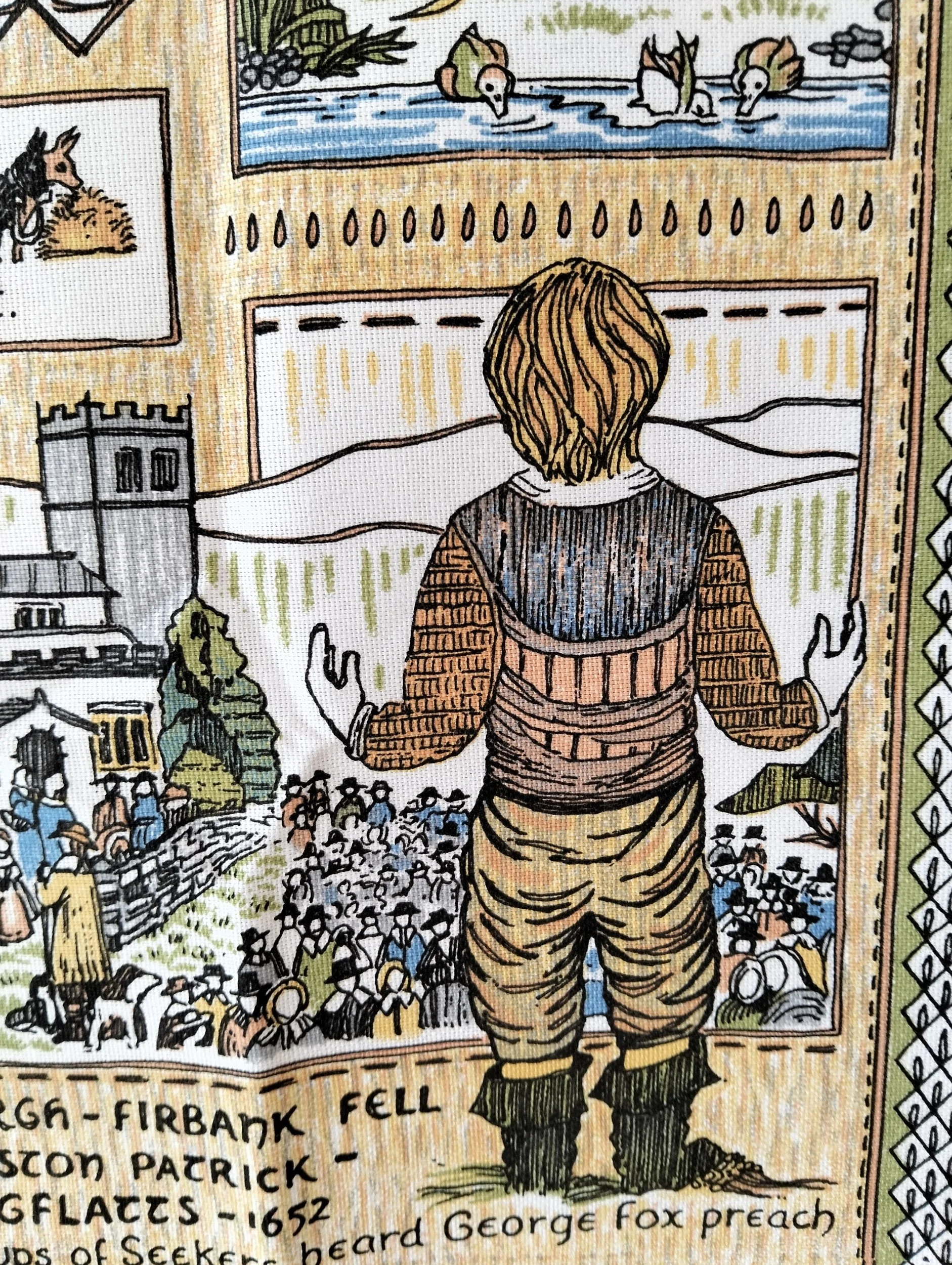
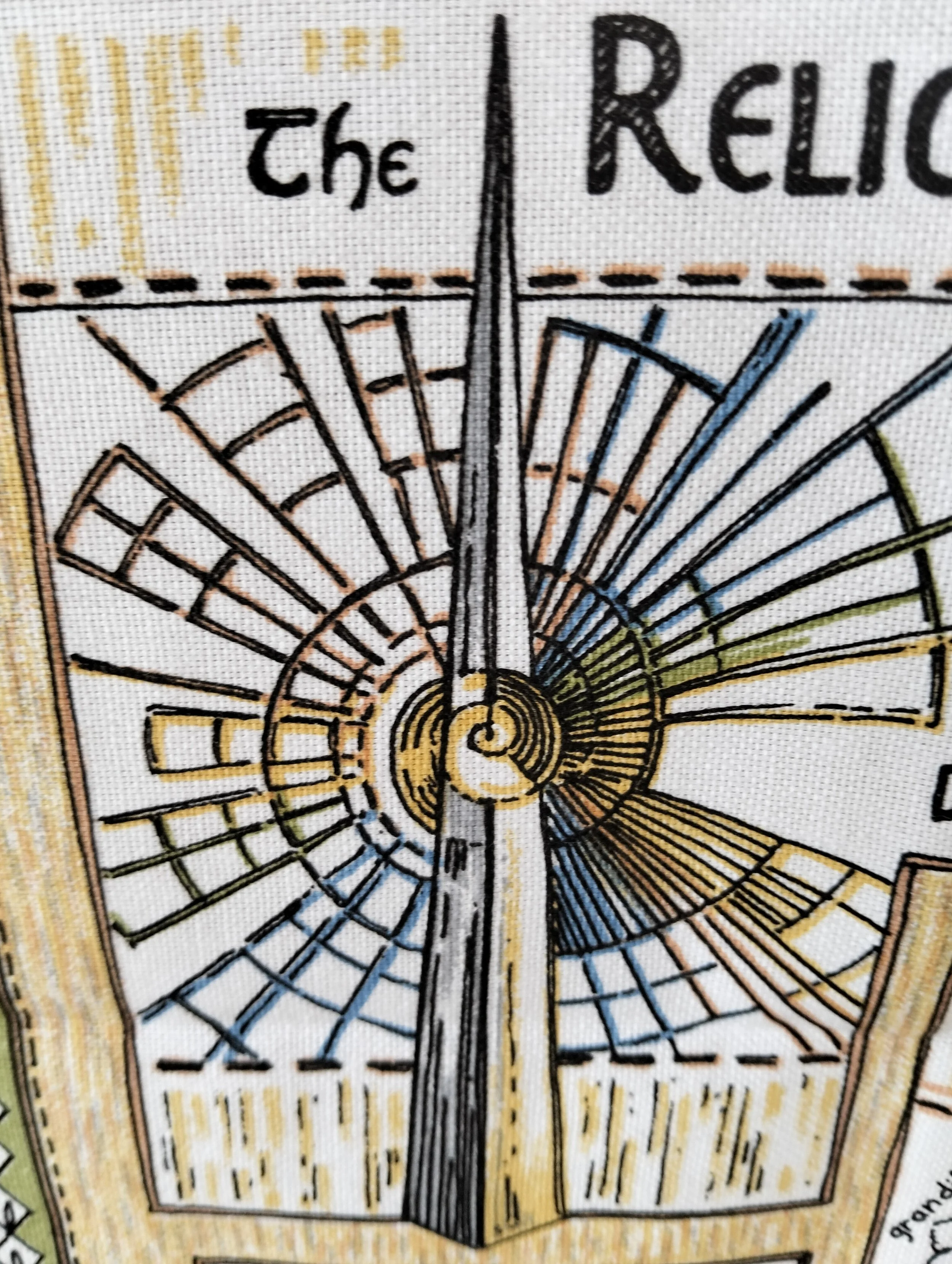
Images from the Quaker Tapestry.