The dream
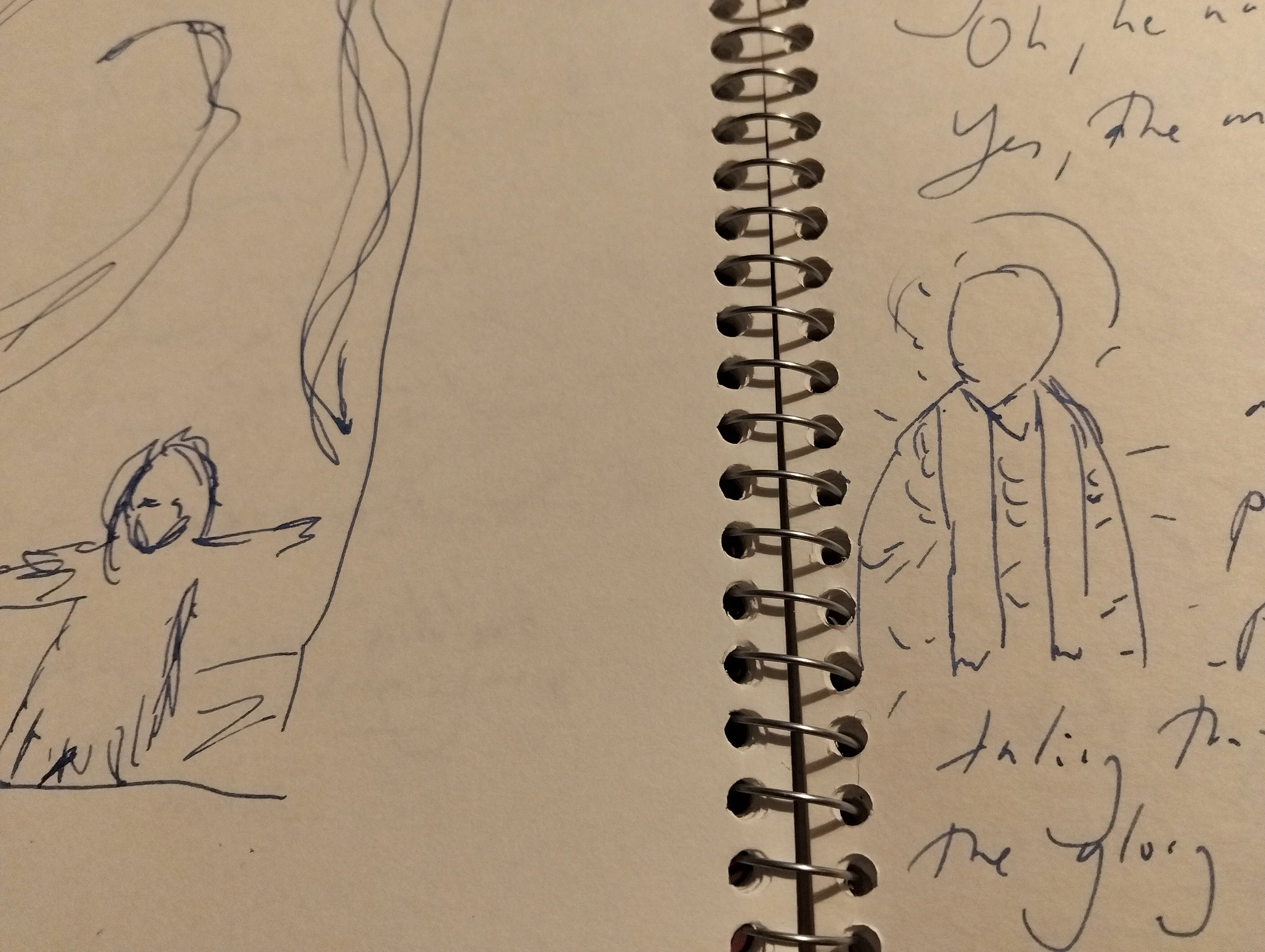
When Christ who is our life appears, then we also will appear with him in glory. (Colossians 3: 4).
1.
As autumn comes to Christchurch, I can smell smoke and mice in the air. It is Lent.
Quakers don’t follow ‘the church year’. The Meetinghouse isn’t stripped or decked out in new colours.
But the flowers on the table are freshly changed, and the light coming in through the windows is different.
2.
At the end of last year, I had a ‘big dream’:
I dream of being inside a little church, like St Peter’s, Teddington, but the congregation feels like “Quakers”, at least officially.
There is a service going on and I’m part of it. It’s joyous, informal, a bit chaotic, and warm.
At one point, I’m looking at the service from a little side space up the front, like a vestry. I’m wearing a plain, beige robe. I think: this is ok, these robes are ok (i.e. not too extravagant). I’m comfortable with this - more than that, I feel special and ‘acknowledged’.
I look through the service and see a lead minister - a youngish woman, with thick hair, wearing clerical robes. She’s sitting on the floor with children and other people. I think: this is ok. I’m comfortable with this (a gowned priest leading a service).
The service continues in an informal, joyous way. There is some music and dancing. My elderly mother, who struggles to move unassisted now, starts dancing.
Time for communion. My children and wife are here. Friends. Randoms. We - the messy, diverse, unlikely congregation - start handing out bread and wafers to each other. It comes in all shapes and types. At one point, I have a piece of freshly buttered naan in my hands. It looks delicious. I wolf it down. I am aware of my (Quaker) objection to outer sacraments - to bread and wine - but this seems ok.
A family member - from whom I am estranged - very reluctantly hands me a small, dry wafer.
The service is over. But now my big moment has arrived. I am to present some research to the congregation. I am about to tell them: it is time to give up this old church and wander off into the grass and surrounding trees and worship there instead. But the congregation have now wandered off. There is a second space at the base of the church. The congregation are here now.
The ‘second space’ at the foot of the church is a square, wood-panelled large room or hall. Some people are sitting on couches with their children, watching TV. I think this would be a great space for a Quaker “meeting for worship”. Indeed, perhaps there is a Quaker group that already uses this space for their meetings. Yes, there is.
I’m changing the speech in my head now - from needing to abandon the old church, to being so impressed with this building and how well it is used. We need to worship here more often!
I lift my head and suddenly see a banner above us. It is green and white. It has an image of Christ’s bearded face painted on it - in black, expressionist brushstrokes. I gasp.
The Anglican Bishop of Christchurch is now making an entrance through a door at the back! He is decked out in all his finery - gold embroidered, red, blue, and white vestments. A sort of shining stole. [Note: the actual Anglican bishop of Christchurch dresses more modestly!]. He has been present all along at the service.
3.
I attend an Ash Wednesday service.
I start reading “Daily Services” from A New Zealand Prayer Book, sometimes sitting in the churchyard at St Cuthbert’s.
I watch an Anglo-Catholic service on YouTube.
It starts coming back...
...in rushes, in big moments: ash smeared on my forehead (tears), the priest singing the Gospel Acclamation (deep memory, heart melts), in the sudden, obvious realization that all Catholic liturgy (done well) is deeply contemplative, in sitting with a client and seeing the Christ in him and me, Christ “in the least” (tender compassion, heart full of blood).
In little moments: the daily round of prayer. A shrine to Mother Mary. An altar boy getting the charcoal hot.
And then the other piece comes back. I know that the church on YouTube is a place of violence, too. Is run, almost exclusively, by men. The congregation is so passive and far away.
I remember how it hasn’t worked in the last few Anglican churches I’ve been a part of. I remember the burning seed of feeling called to ordained priesthood, and how I began to pursue this and then gave it up.
It feels impossible. I am a Catholic Christian. It’s in my blood. It’s how I most explicitly encounter Christ, and how I am encountered by, and, I want to say, “bewitched by Christ”. This is how Christ got under my skin. Gets under my skin.
Not through the ‘evangelical’ gate, with its own style of preaching, conversion, and atonement.
I have attended Anglican Churches in my adult years on this basis: in sacrament, symbol, beauty, the Gospel, the seasons, all of us, the least, blood and fire. Simply, they have been the best, most inclusive, “holy, catholic and apostolic” churches on the block at the time.
It is not impossible to be a Quaker and a Catholic Christian (1). There are all sorts of contrasts, and, in many ways, contradictions. Yet both, in different ways, revere the Real Presence in their liturgies, have a more optimistic view of human beings (than some other Christian traditions), have a more “synergistic” approach to salvation, and a central “appreciation of sanctity and of mysticism” in their testimonies and practice (2).
You don’t have to believe - or not believe - anything to be a Quaker. In the heart of silence, I am refreshed from a surfeit of too many symbols and words. I wait on and receive the Spirit (sometimes in symbols).
What feels more impossible is finding a church to practice my Catholic faith in, right now.
I think of all the people I know, and who are dear to me, who would be excluded from a Roman Catholic Eucharist (and all that this means). My wife. My kids. My mother, a committed Christian of eighty-seven years. So many friends who are deeply committed Christians, but who weren’t baptized in a Roman Catholic church . My divorced Catholic friends. Most of these people are women!
The Anglican Church is a grace, at times, even as it creaks far too slowly towards just and loving inclusion of rainbow people. But its local churches around me, including the more Catholic-minded ones, feel impossible right now.
4.
As this broken bread was scattered over the hills and then, when gathered, became one mass, so may your Church be gathered from the ends of the earth into your kingdom.
(The Didache, AD 90).
5.
In visions, while sitting in silence, I keep seeing the colour red: plump hawthorn berries, a deep red sash around our dog.
6.
This Lent, I have decided to repent feeling hopeless and despairing about the Church and my place in it, without giving up on my sense of what is right and what is not ok. This is a very hard practice for me to do.
I am reading the Gospel of Luke. It begins with Elizabeth and Zechariah, the parents of John the Baptist. They have been waiting a long time for a child, and have, maybe, given up.
Zechariah lights incense in a shrine to the Lord. He sees a vision and is promised the impossible. He doesn’t believe it, so has to take it into silence. He is made speechless “until the day these things occur”, when the child is born and named.
References
(1) John Corry, “On Being a Catholic Quaker”, Friend’s Journal, February 2008; “What Quakers and Catholics Might Learn From Each Other”, Friend’s Journal, May, 2015.
(2) Michael Mullett, “A Catholic Looks at Quakerism”, Quaker Studies (2) 1997, p.64.