Lent and the triple way
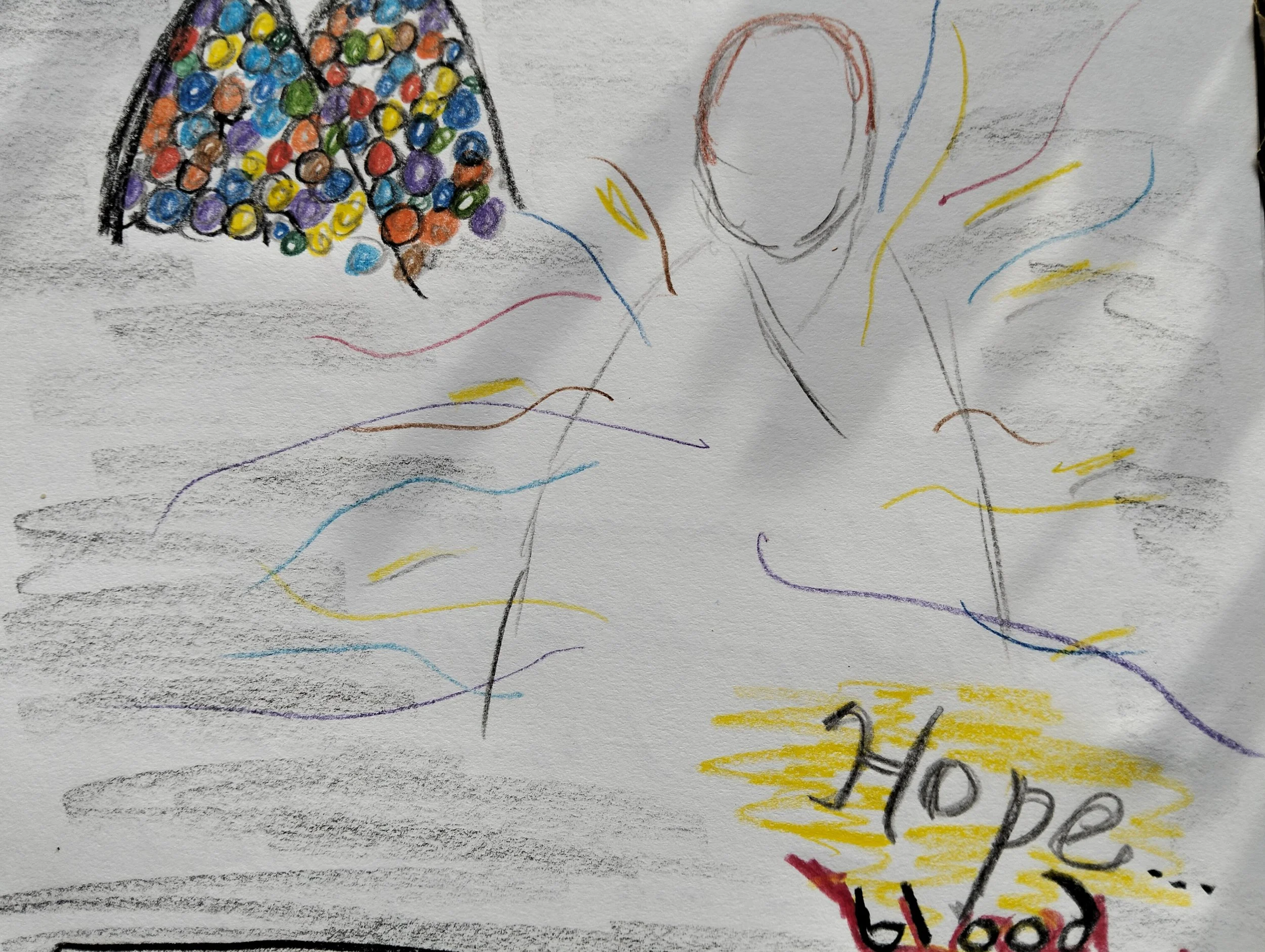
I have been meditating on the vision I received on Shrove Tuesday:
A crocheted, black shawl with colourful, circular ‘medallions’. I put it on. As soon as it touches my shoulders, the garment becomes pure, gleaming white. The words “hope” and “blood” appear.
If I really believe in the priesthood of all believers, perhaps I had better put my money where my mouth is - and be willing to accept this as an image of my priestly vestments!
One person, Moya, commented:
I was fascinated by your visions and the one about the white robe, ‘hope’ and ‘blood’ reminds me of an old hymn:
‘My hope is built on nothing less than Jesus’ blood and righteousness…’
And I think it ends with:
‘Clothed in his righteousness alone,
Faultless, I stand before the throne.’
To which I responded: Gulp! Maybe…I’m open to it…though such hymns aren’t indigenous to my heart!
On Sunday, in Meeting for Worship, when the stillness came, I turned to this image of the white robe…
I became aware that what we call waiting on the spirit (in the Quaker tradition), or simply contemplative or silent prayer (in the Catholic tradition), often involves such a purifying transformation. That is, a shift from a more fragmented, pluriform, weighed down, overwhelmed, conflicted, ‘out of the Presence’, ‘sinful’ or ‘estranged’ sort of state, to a more pure, clear, refreshed, worshipful, loving, peaceful, simple, gathered, ‘in the Presence’ state of being (or awareness of Being).
I go from feeling tired and a bit shitty, and distant from others in the room, to feeling centred, refreshed, and more loving again.
It’s not just that our perspective has changed. It feels like an energetic change too - a bodily, neurological shift - and improvement!
The word purification came to me as a description of this “process”. I then remembered that this wasn’t an original thought.
Attributable to no one in particular, but coming down through centuries of contemplative experience and reflection ( c/f. Clement of Alexandria, Dionysius, Saint Bonaventure etc.), Christian mysticism speaks of a triple way in the life of spirituality and transformation. Sometimes, the exact order of these ways is rendered or described differently. Sometimes, they are seen as linear, progressive stages. Other times, they are treated as co-existing. In general, the triple way includes:
Purification or the purgative way- an initial “stage”, “movement”, or “way” that involves catharsis, confession, and inward cleansing of one’s “sins”, entanglements, wounds, existence, and/or “false self”.
Illumination or the illuminative way - where the mind, heart, and body are filled with greater clarity, insight, light, truth, stillness, health, holiness, and/or wisdom.
Union or the contemplative way - involving oneness with God, usually in love, peace, and silence.
Lent is a purgative time. I have always found it difficult to connect with the language of Christ’s sacrificial blood washing me clean of my sins, establishing me in “righteousness”. Such symbolism - at first glance, at least - emphasises the moral dimension of purification, a central concern of the Jewish tradition. It also focuses us on images and metaphors of actual, bloody sacrifice - which feel other and alien to me, although they are a central part of Jewish custom, ritual, and narrative.
I’m not saying I’ve lived a very good life all the time! And I’m not suggesting that sacrifice isn’t central to life and faith, in some sense. But often my problems and estrangement (from my ‘true self’, others, and God) have been centred on other levels than the moral - or are more persistently embedded at deeper levels.
There is a moral dimension to purification, to purgation, of course. It is wholly unwise to skip or submerge this, or to consider that one has transcended it for good! But is it possible that the Church- for reasons - has emphasized the moral, and placed less emphasis on other layers and dimensions?
This is perhaps why we need to hear from creative contemplatives, such as Father Thomas Keating, to broaden and refresh our theology and vision. Integrating insights from depth psychotherapy - a notable, contemporary purgative way - Keating defines purification as:
an essential part of the process of contemplation through which the dark side of one’s personality, mixed motivation, and the emotional pain of a lifetime, stored in the unconscious, are gradually evacuated; the necessary preparation for transforming union. (1)
Is it possible to embrace a deeper and more holistic view of the purgative way this Lent?
As I write this, I feel myself ‘sickening’ - purgation on a bodily level!
Reference
(1) Thomas Keating, The Foundations of Centering Prayer and the Christian Contemplative Life (2011), .249.